In short
Western synastry compares planet-to-planet contacts between two charts; Vedic astrology starts from the Moon and scores a match out of 36 with Ashtakoot guna milan, then checks Mars, the 7th house, the Navamsa and both partners' Dashas. What each method measures, what each misses, and how any couple - Indian or not - can use the Vedic one.
- Western synastry
- Aspects between two charts, house overlays, composite and Davison charts
- Vedic Ashtakoot
- 8 factors from both Moon signs and Nakshatras, scored out of 36; 18+ is the customary pass
- Heaviest factors
- Nadi (8 points) and Bhakoot (7 points)
- Beyond the score
- Mangal Dosha, 7th house and its lord, Venus, Navamsa (D9) and both Dashas
- Birth time
- Not essential for the score; needed for houses, Mangal Dosha from the Ascendant and the Navamsa
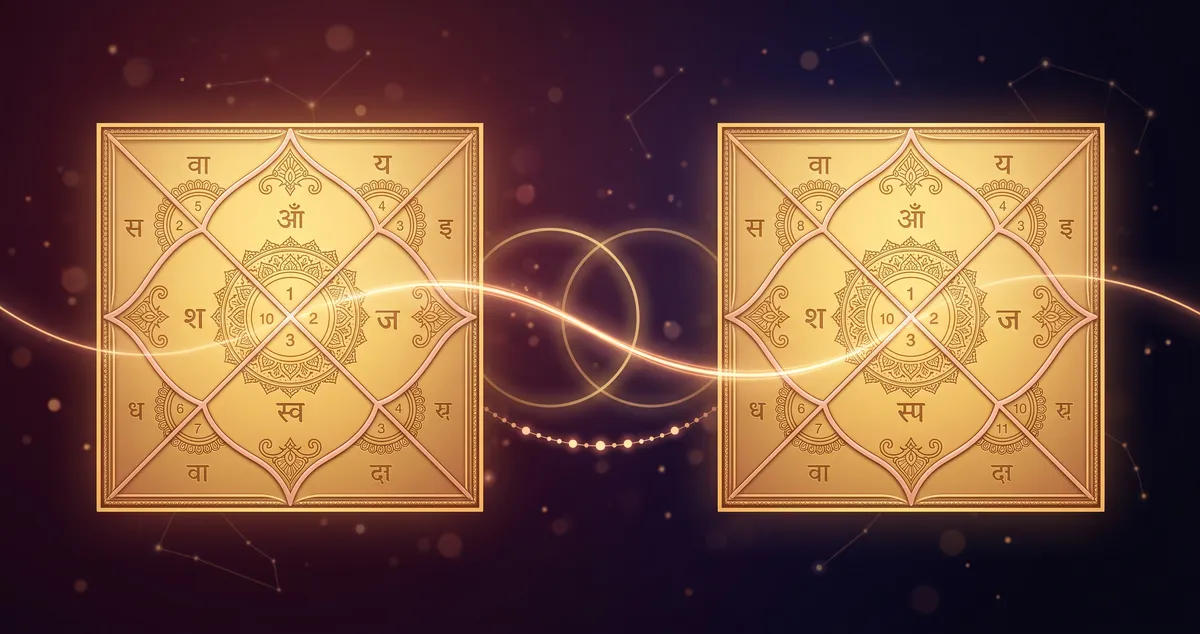
Western and Vedic astrology both compare two birth charts to judge a relationship, but they begin in different places. Western synastry looks at how one person's planets aspect the other's - Venus trine Mars, Saturn on the Moon - and at composite charts built from the pair. Vedic astrology starts with the Moon: Ashtakoot guna milan scores the match out of 36 from both partners' Moon signs and Nakshatras, and a proper Vedic match then reads Mars, the 7th house, the Navamsa chart and the timing of both partners' planetary periods. This guide compares the two methods, explains what the 36-point score does and does not tell you, and shows how any couple can use the Vedic approach alongside what they already know.
How Western Synastry Works
Synastry overlays two natal charts and reads the aspects between them. Contacts between the Sun and Moon, Venus and Mars, or the Ascendants are taken as attraction and ease; Saturn contacts as commitment or weight; outer-planet contacts as intensity. House overlays show where each person's planets fall in the other's chart. Many astrologers add a composite chart (the midpoints of each pair of planets) or a Davison chart (a chart cast for the midpoint in time and space) to read the relationship as an entity of its own.
Synastry is flexible and descriptive. It is very good at showing chemistry and friction, and it has no pass mark - which is both its strength and why two astrologers can read the same pair differently.
How Vedic Compatibility Works: Ashtakoot Guna Milan
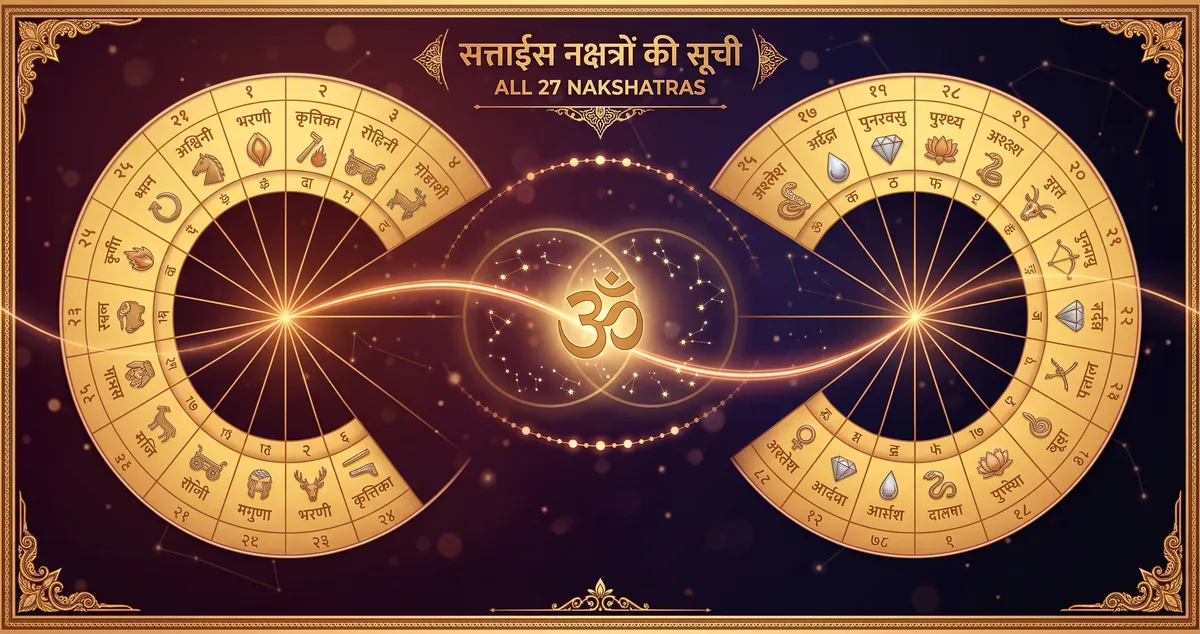
Ashtakoot ('eight factors') compares the two Moons. Each factor checks a different dimension of compatibility and carries a different weight, totalling 36 points. By convention 18 or more is acceptable, 25 or more is good and above 32 is exceptional.
| Koota | Points | What it compares |
|---|---|---|
| Varna | 1 | Temperament and spiritual outlook |
| Vashya | 2 | Mutual influence and attraction |
| Tara | 3 | Birth-star harmony and wellbeing |
| Yoni | 4 | Physical and instinctive compatibility |
| Graha Maitri | 5 | Friendship between the Moon-sign lords; mental rapport |
| Gana | 6 | Basic nature (deva, manushya, rakshasa) |
| Bhakoot | 7 | Relative position of the Moon signs; family welfare and prosperity |
| Nadi | 8 | Constitution; traditionally linked to health and children |
What the Vedic Method Adds Beyond the Score
The score is only a first filter, and an experienced Vedic astrologer never stops there. Nadi and Bhakoot together carry 15 of the 36 points, so a modest score with no dosha can be sounder than a high one with Nadi dosha. Then the charts themselves are read, much as in synastry but through Jyotish tools:
- Mangal DoshaMars in the 1st, 2nd, 4th, 7th, 8th or 12th from the Ascendant, Moon or Venus, and the classical exceptions that cancel it
- The 7th house and its lordin both charts, and Venus as the significator of relationships
- Navamsa (D9)the divisional chart traditionally read for marriage and the inner life of the partnership
- Darakarakathe Jaimini spouse significator, the planet with the lowest degree
- Dasha timingwhether both partners' planetary periods support commitment in the same years - something synastry has no tool for
Synastry vs Ashtakoot: Strengths and Blind Spots
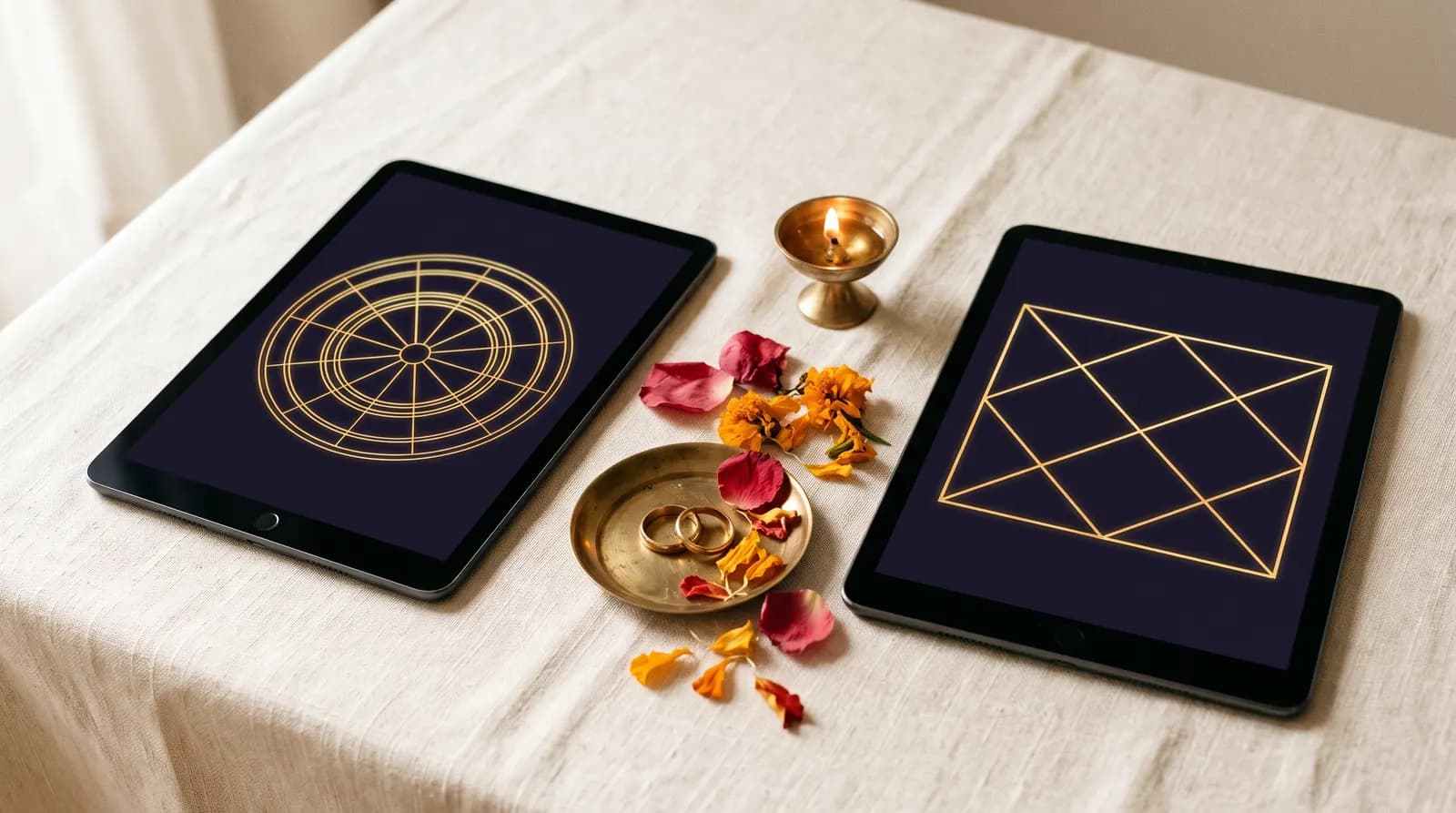
Each method sees something the other misses. Synastry captures chemistry well and adapts to any kind of relationship, but it has no agreed threshold and no built-in sense of timing. Ashtakoot is standardised and quick, and needs little more than birth dates, but on its own it compares only the two Moons. Used together - the score as a check, the full charts for depth, the Dashas for timing - they make a more complete picture than either alone.
| Western synastry | Vedic matching | |
|---|---|---|
| Starting point | All planets and angles | The two Moons (sign and Nakshatra) |
| Zodiac | Tropical | Sidereal |
| Output | Descriptive reading | Score out of 36, then a reading |
| Pass mark | None | 18 of 36 by convention |
| Timing | Transits to both charts | Both partners' Dashas plus transits |
| Birth time needed | For angles and houses | Not for the score; yes for houses and Navamsa |
Can a Non-Indian Couple Use Vedic Compatibility?
Yes. Ashtakoot is calculated from the positions of the Moon, so it works for any couple born anywhere; the only thing that matters is an accurate date, time and place for each partner, with the local time zone of the birth town. You do not need an arranged-marriage context to find it useful - many couples treat the score and the reading as a second lens on a relationship they already understand through Western synastry.
Two practical notes. Because Vedic astrology is sidereal, your Moon signs are often one sign earlier than in your Western charts, so do not feed Western Moon signs into a Vedic calculator. And if the Moon changed Nakshatra on either birthday, the score can depend on the birth time; the free calculator flags this.
The takeaway
Western synastry describes chemistry through planet-to-planet contacts; Vedic compatibility starts from the two Moons with the 36-point Ashtakoot score, then reads Mars, the 7th house, the Navamsa and both partners' Dashas. Neither replaces the other. Run the free 36 guna check for your own pair, and if the result raises questions - or you want to know how your periods line up in the years ahead - a matching consultation reads both charts in full.
Book Kundali Matching