In short
The 27 nakshatras are the real backbone of Vedic astrology - finer than the twelve rashis and the basis of the entire Vimshottari Dasha system. Here is the complete list with each nakshatra's ruling planet, deity, symbol and degrees, plus how to find your own janma nakshatra and what it governs.
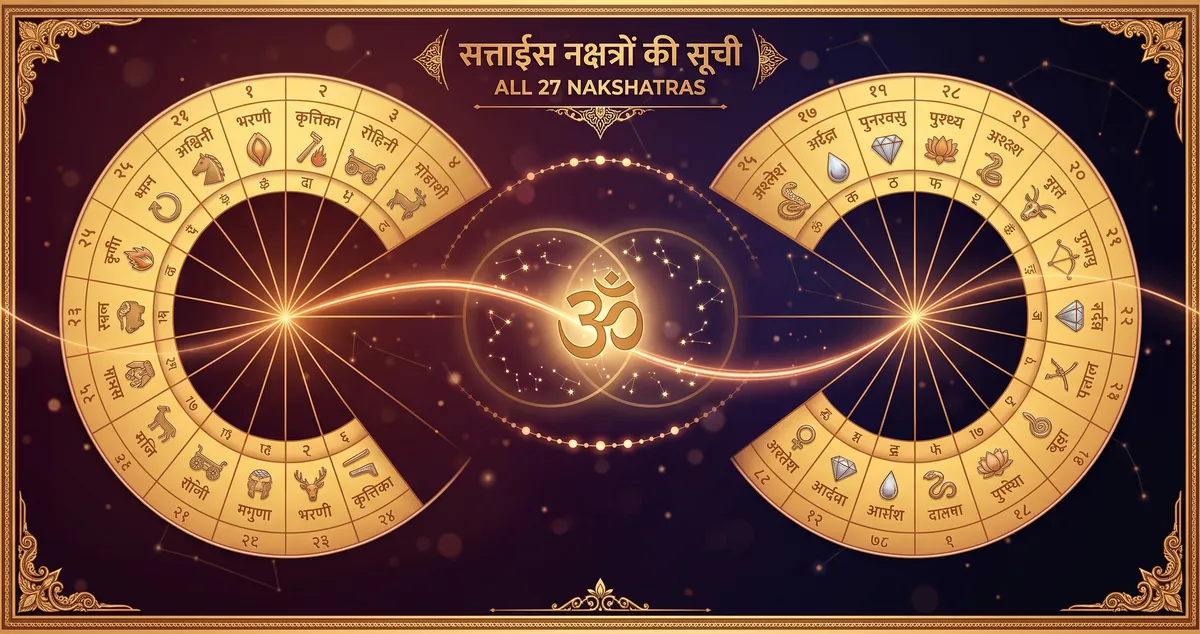
Most people meet Vedic astrology through the twelve rashis, but the older and finer division is the nakshatra - the twenty-seven lunar mansions the Moon passes through in a single sidereal month. Each spans exactly 13 degrees 20 minutes of the zodiac, and together they cover the full 360 degrees. This matters practically rather than academically: your Vimshottari Dasha sequence, the timing system that decides when anything in your chart actually happens, is calculated entirely from the Moon's nakshatra position at birth. Muhurat selection, Ashtakoot compatibility matching and most remedial prescriptions also work at nakshatra level rather than sign level. This guide gives the complete list with each nakshatra's span, ruling planet, presiding deity and symbol, explains how to find your own janma nakshatra, and shows what the system is actually used for.
What Is a Nakshatra and Why Does It Matter More Than Your Rashi?
A nakshatra is one of twenty-seven equal divisions of the sidereal zodiac, each measuring 13 degrees 20 minutes. Where a rashi is a thirty-degree band, a nakshatra is less than half that width, so it locates a planet far more precisely. The Sanskrit term means roughly 'that which does not decay' - the fixed stars against which the Moon's movement was originally measured.
The practical importance is that Vedic astrology's primary timing system runs on nakshatras, not signs. The Vimshottari Dasha sequence begins from the exact degree the Moon occupied within its nakshatra at your birth, and that starting point determines which planetary period you are running for the next 120 years. Two people born on the same day in the same city can run entirely different Dashas because their Moons sat in different nakshatras or different padas.
Nakshatras also carry the finer texture of a chart. The rashi describes the broad field a planet operates in; the nakshatra describes its temperament, its motive and the deity it answers to. A Moon in Cancer says one thing; a Moon in Cancer in Ashlesha says something considerably more specific.
- Total count27 nakshatras spanning the full 360-degree sidereal zodiac
- Span of each13 degrees 20 minutes, subdivided into four padas of 3 degrees 20 minutes
- GovernsVimshottari Dasha timing, Muhurat selection, Ashtakoot compatibility, remedial prescription
- Your janma nakshatrathe nakshatra occupied by the Moon at the moment of your birth
- Why sign alone is not enougha 30-degree rashi covers between two and three different nakshatras
The Complete List of 27 Nakshatras with Lords, Deities and Symbols
The list runs in zodiacal order from 0 degrees Aries. The ruling planet, or nakshatra lord, is what determines the Vimshottari Dasha sequence; the presiding deity and symbol carry the interpretive meaning.
- 1. Ashwini(0°00'-13°20' Aries) - Lord Ketu, deity Ashwini Kumaras, symbol a horse's head. Speed, healing, fresh starts.
- 2. Bharani(13°20'-26°40' Aries) - Lord Venus, deity Yama, symbol the yoni. Restraint, endurance, transformation.
- 3. Krittika(26°40' Aries-10°00' Taurus) - Lord Sun, deity Agni, symbol a blade. Sharpness, purification, cutting through.
- 4. Rohini(10°00'-23°20' Taurus) - Lord Moon, deity Brahma, symbol an ox-cart. Growth, beauty, material abundance.
- 5. Mrigashira(23°20' Taurus-6°40' Gemini) - Lord Mars, deity Soma, symbol a deer's head. Searching, curiosity, restlessness.
- 6. Ardra(6°40'-20°00' Gemini) - Lord Rahu, deity Rudra, symbol a teardrop. Storm, upheaval, breakthrough after grief.
- 7. Punarvasu(20°00' Gemini-3°20' Cancer) - Lord Jupiter, deity Aditi, symbol a quiver of arrows. Return, renewal, second chances.
- 8. Pushya(3°20'-16°40' Cancer) - Lord Saturn, deity Brihaspati, symbol a cow's udder. Nourishment, the most auspicious nakshatra for most undertakings.
- 9. Ashlesha(16°40'-30°00' Cancer) - Lord Mercury, deity the Nagas, symbol a coiled serpent. Insight, strategy, hidden knowledge.
- 10. Magha(0°00'-13°20' Leo) - Lord Ketu, deity the Pitrs, symbol a throne. Ancestry, lineage, inherited authority.
- 11. Purva Phalguni(13°20'-26°40' Leo) - Lord Venus, deity Bhaga, symbol a hammock. Pleasure, rest, creative enjoyment.
- 12. Uttara Phalguni(26°40' Leo-10°00' Virgo) - Lord Sun, deity Aryaman, symbol a bed. Patronage, contracts, steady partnership.
- 13. Hasta(10°00'-23°20' Virgo) - Lord Moon, deity Savitar, symbol an open hand. Skill, craft, dexterity.
- 14. Chitra(23°20' Virgo-6°40' Libra) - Lord Mars, deity Tvashtar, symbol a bright jewel. Design, brilliance, form.
- 15. Swati(6°40'-20°00' Libra) - Lord Rahu, deity Vayu, symbol a young shoot in wind. Independence, flexibility, trade.
- 16. Vishakha(20°00' Libra-3°20' Scorpio) - Lord Jupiter, deity Indragni, symbol a triumphal arch. Ambition, single-minded pursuit.
- 17. Anuradha(3°20'-16°40' Scorpio) - Lord Saturn, deity Mitra, symbol a lotus. Friendship, devotion, working with others.
- 18. Jyeshtha(16°40'-30°00' Scorpio) - Lord Mercury, deity Indra, symbol an earring. Seniority, protection, hidden power.
- 19. Mula(0°00'-13°20' Sagittarius) - Lord Ketu, deity Nirriti, symbol tied roots. Getting to the root, dissolution, investigation.
- 20. Purva Ashadha(13°20'-26°40' Sagittarius) - Lord Venus, deity Apas, symbol a winnowing fan. Invincibility, conviction.
- 21. Uttara Ashadha(26°40' Sagittarius-10°00' Capricorn) - Lord Sun, deity Vishvadevas, symbol an elephant tusk. Lasting victory, integrity.
- 22. Shravana(10°00'-23°20' Capricorn) - Lord Moon, deity Vishnu, symbol an ear. Listening, learning, transmission of knowledge.
- 23. Dhanishta(23°20' Capricorn-6°40' Aquarius) - Lord Mars, deity the Vasus, symbol a drum. Rhythm, wealth, music, mechanised output.
- 24. Shatabhisha(6°40'-20°00' Aquarius) - Lord Rahu, deity Varuna, symbol an empty circle. Healing, secrecy, a hundred physicians.
- 25. Purva Bhadrapada(20°00' Aquarius-3°20' Pisces) - Lord Jupiter, deity Aja Ekapada, symbol a funeral cot. Intensity, austerity, the mystical edge.
- 26. Uttara Bhadrapada(3°20'-16°40' Pisces) - Lord Saturn, deity Ahir Budhnya, symbol the depths. Wisdom, patience, deep calm.
- 27. Revati(16°40'-30°00' Pisces) - Lord Mercury, deity Pushan, symbol a fish. Safe passage, completion, nourishment of others.
How Do I Find My Nakshatra?
Your janma nakshatra is determined by the Moon's exact position at your moment of birth, so you need your date, time and place of birth. The Moon moves through roughly one nakshatra per day, which means the birth date alone will usually narrow it to one or two candidates - but not always reliably, because the Moon can change nakshatra at any hour of the day or night.
This is also why an accurate birth time matters more than most people expect. If your Moon sat near the boundary between two nakshatras, an error of even an hour can shift your janma nakshatra and, with it, your entire Vimshottari Dasha sequence. Where the birth time is genuinely unknown, Birth Time Rectification works backwards from dated life events to establish it before any prediction is built on top.
Your rashi tells you which room you are standing in. Your nakshatra tells you where in that room, and which direction you are facing.
- You needexact date, exact time and place of birth
- Sidereal, not tropicalVedic calculation uses the sidereal zodiac with an ayanamsa correction of roughly 24 degrees, so a Western chart will give a different answer
- Pada matters tooeach nakshatra divides into four padas, which place the Moon in different Navamsha signs and refine the reading further
- Boundary casesif the Moon was near the edge of a nakshatra, an inaccurate birth time can change the result entirely
What Are Nakshatra Padas and Why Do They Matter?
Each nakshatra divides into four quarters called padas, of 3 degrees 20 minutes each. Since 27 nakshatras multiplied by 4 padas produces 108 divisions - and 108 is also the number of divisions in the Navamsha, or D-9 chart - each pada maps onto one Navamsha sign.
That mapping is what makes padas practically important. The Navamsha is the primary divisional chart for marriage and for the underlying strength of any planet, so two people born in the same nakshatra but different padas can have quite different marital indications and different planetary strengths, despite sharing a janma nakshatra.
- Pada span3 degrees 20 minutes, four to each nakshatra
- Total padas108, matching the 108 divisions of the Navamsha chart
- Primary useNavamsha placement, which governs marriage and planetary strength
- Also used forthe first syllable traditionally chosen for a child's name
What Is a Nakshatra Actually Used For in Practice?
The nakshatra system is not decorative. Four working parts of Vedic astrology depend on it directly, and a reading that ignores nakshatras is working at a much coarser resolution than the tradition intends.
- Vimshottari Dashathe entire 120-year timing sequence starts from the Moon's nakshatra and its lord. This is the single most important application.
- Muhurat selectionauspicious timing for weddings, business launches, property registration and childbirth is chosen partly by which nakshatra the Moon occupies that day.
- Ashtakoot Guna Milanseveral of the eight kootas in marriage matching - including Nadi, Yoni, Gana and Tara - are computed from the two janma nakshatras rather than from the signs.
- Remedial prescriptionthe nakshatra lord and presiding deity indicate which mantra, which weekday and which form of charity are appropriate, which is why generic remedies often achieve little.
- Gandanta identificationthe junctions between water and fire nakshatras mark karmically sensitive degrees requiring particular care in both prediction and Muhurat.
Nakshatras Covered in Depth on This Site
Several nakshatras are treated at length in dedicated guides, usually because a major transit or festival brought them into focus. Each explains the nakshatra's deity, symbolism and effects in a real astrological context rather than in the abstract.
- Ashlesha- the serpent star, examined through Jupiter's 2026 transit and the Ashlesha-Magha Gandanta boundary. See the Jupiter in Ashlesha guide.
- Shatabhisha- the hundred healers, ruled by Rahu, covered through the August 2026 lunar eclipse.
- Rohini- the Moon's favourite nakshatra and the star of Krishna's birth, covered in the Janmashtami guide.
- Magha- the ancestral throne, ruled by Ketu, relevant to both the eclipse axis and Pitru Paksha.
- Dhanishta- the drum of the Vasus, currently occupied by Rahu until the December 2026 nodal shift.
The takeaway
The twenty-seven nakshatras are the layer at which Vedic astrology actually does its timing work. Knowing your rashi tells you something; knowing your janma nakshatra, its lord, its pada and the Dasha sequence flowing from it tells you when. If you want your own nakshatra identified accurately, your Vimshottari Dasha mapped from it, and remedies matched to your nakshatra lord rather than to a generic sign, book a 1-on-1 video consultation with Astrologer Sheela Goklani. If your birth time is uncertain, start with Birth Time Rectification - every conclusion above rests on the Moon's exact position, and that is worth establishing properly first.