In short
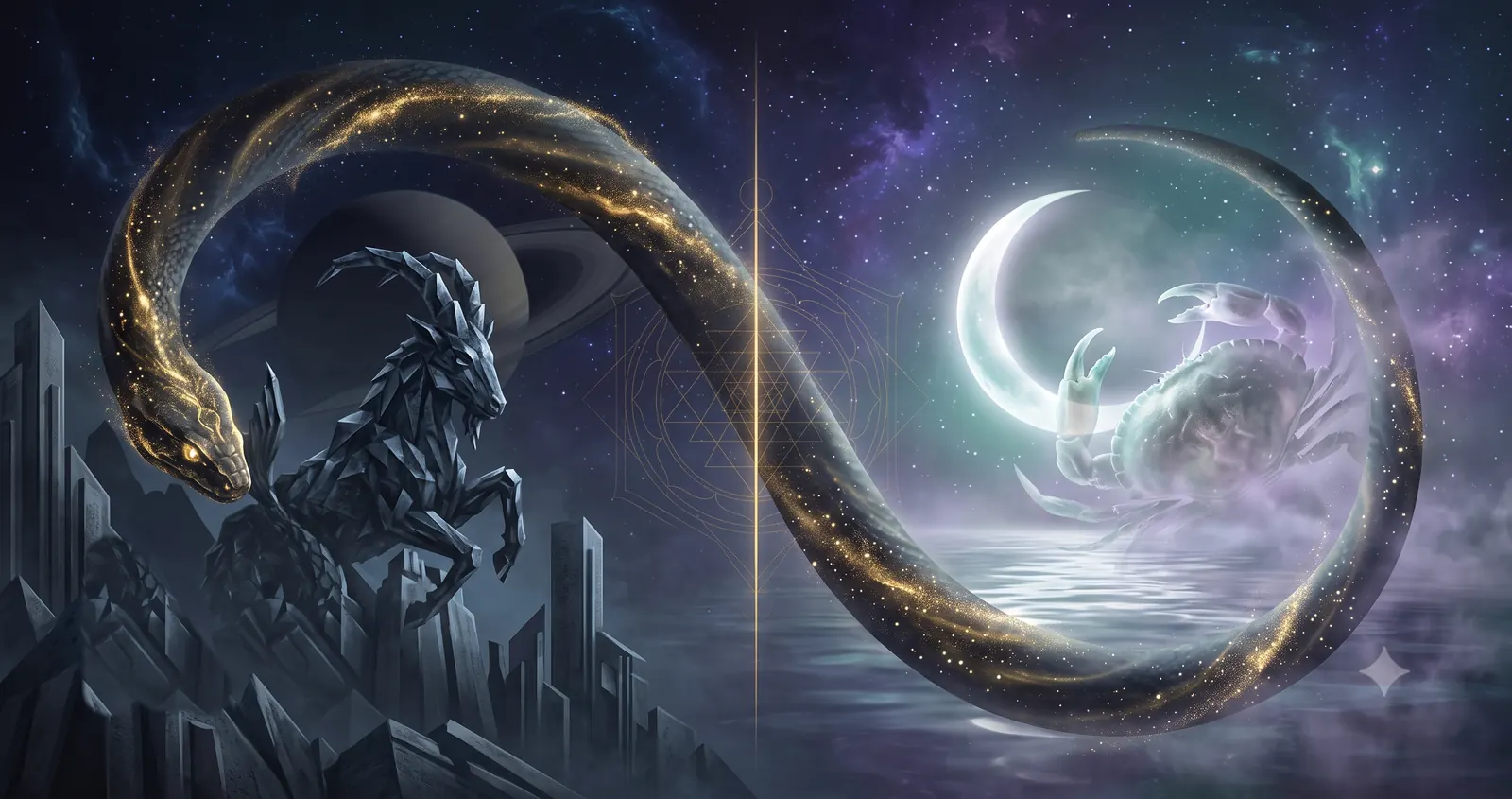
Rahu and Ketu are not planets but the two points where the Moon's orbit crosses the Sun's path - the North and South Nodes of Western astrology. Jyotish counts them as shadow planets with their own Dashas and Nakshatras. What the nodes are, how Vedic and Western readings of them compare, how to read the axis in your chart, and what the December 2026 nodal shift brings.
- Rahu
- North (ascending) Node of the Moon
- Ketu
- South (descending) Node, always exactly opposite Rahu
- Cycle
- About 18.6 years through the zodiac, roughly 18 months per sign, moving backwards
- Dashas
- Rahu Mahadasha 18 years; Ketu Mahadasha 7 years
- Next shift
- Rahu into sidereal Capricorn and Ketu into Cancer on December 5, 2026
Rahu and Ketu are the two lunar nodes - the points where the Moon's tilted orbit crosses the ecliptic, the Sun's apparent path. Western astrology calls them the North Node and South Node and usually reads them as a single axis of growth and habit. Vedic astrology goes further: it counts Rahu and Ketu among the nine grahas, gives them their own Nakshatras and their own Dasha periods of 18 and 7 years, and treats them as among the most powerful influences in a chart. This guide explains what the nodes are, how Jyotish reads them, how to look at the axis in your own chart and what changes when they move into new signs in December 2026.
What Rahu and Ketu Are, Astronomically
The Moon's orbit is tilted about 5° to the plane of Earth's orbit, so twice a month the Moon crosses the ecliptic: once heading north (the ascending node, Rahu) and once heading south (the descending node, Ketu). The two points are always exactly 180° apart.
Eclipses can only happen when the Sun is near one of these points, which is why Indian myth tells of Rahu and Ketu swallowing the Sun and Moon. The nodes slide backwards through the zodiac, completing a circuit in about 18.6 years and spending roughly 18 months in each sign. Indian Panchangs, and the calculators on this site, use the mean node; the true node wobbles around it by up to about 1.5°.
Vedic vs Western: How the Nodes Are Read
In modern Western astrology the North Node is often read as the direction of growth or soul purpose and the South Node as comfortable, inherited patterns. Jyotish shares the outline but is more concrete and more cautious.
- Rahu (North Node)appetite, ambition and the unfamiliar - foreign places, technology, unconventional paths, sudden rises; it amplifies whatever it touches and can bring obsession or confusion
- Ketu (South Node)detachment, past mastery and the spiritual - research, intuition, letting go; it can bring loss of interest or abrupt separation in the area it occupies
- Shadow planets (chhaya graha)they have no body, so they give the results of the planet ruling their sign and of the planets they join
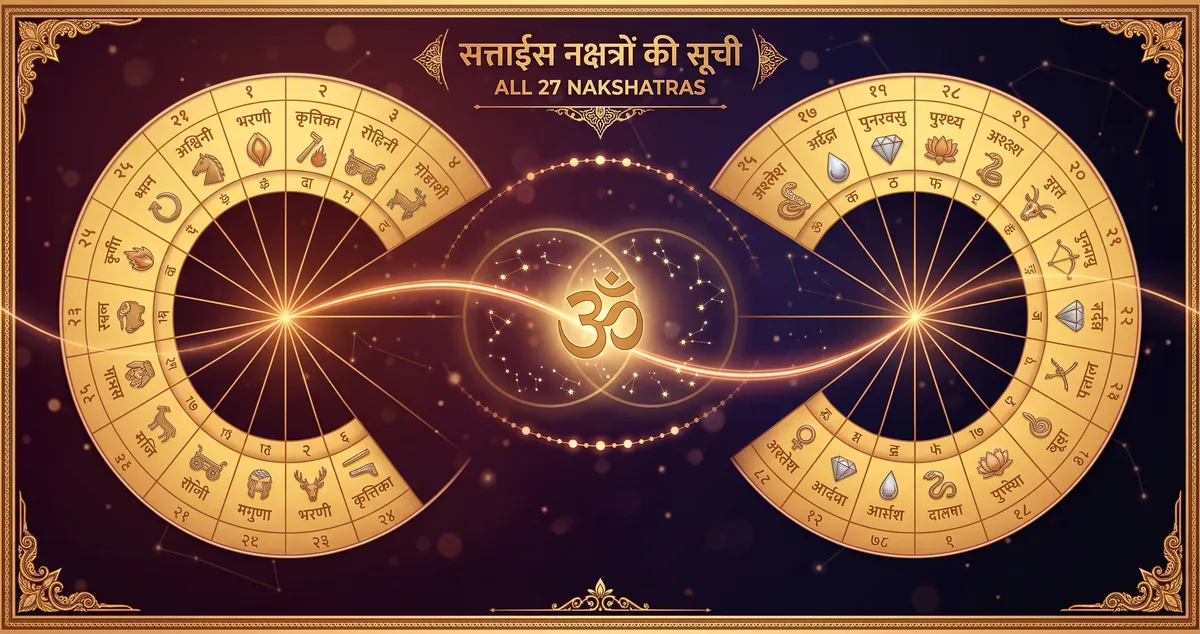
- NakshatrasRahu rules Ardra, Swati and Shatabhisha; Ketu rules Ashwini, Magha and Mula
- Timingeach has a Mahadasha in the 120-year Vimshottari cycle - Rahu 18 years, Ketu 7 years - which Western astrology has no equivalent for
Reading the Rahu-Ketu Axis in Your Chart
Because the nodes are always opposite, they fall in a pair of houses that sit across from each other: 1 and 7, 2 and 8, 3 and 9, 4 and 10, 5 and 11, or 6 and 12. The pair of houses names the life theme your chart keeps working on - self and partnership, own resources and shared ones, learning and belief, home and career, creativity and community, service and release.
Rahu shows where you are hungry and where life keeps pushing you into the new; Ketu shows where you are already skilled but restless or detached. A Vedic astrologer then looks at the lord of each node's sign, any planet conjunct a node (a planet with Rahu is magnified and sometimes distorted; with Ketu it is internalised), and the Nakshatra each node sits in.
- Find the housesthe free birth chart shows the sign, house and Nakshatra of both nodes
- Find the dispositorsthe planets that rule Rahu's and Ketu's signs carry much of their result
- Check conjunctionsa Sun, Moon or Venus with a node is a key feature of the chart
- Check the Dashathe nodes speak loudest in their own Mahadashas and Antardashas
Rahu and Ketu Dashas
Rahu Mahadasha lasts 18 years and often coincides with ambition, relocation, unconventional careers or a hunger for status - and with restlessness, because Rahu is never quite satisfied. Ketu Mahadasha lasts 7 years and tends to strip away what is no longer essential; many people describe it as a period of inward turning, research or spiritual interest, sometimes after an abrupt ending.
Neither is good or bad on its own. A well-placed Rahu in the 10th or 11th house can bring the most visible success of a lifetime; a Ketu period can be the most clarifying. The node's sign lord and house decide how the period actually runs.
The Nodes in Transit: December 2026
Rahu has been in sidereal Aquarius and Ketu in Leo since May 2025. On December 5, 2026 Rahu moves into Capricorn and Ketu into Cancer, where they stay until mid-2028. Because the nodes move backwards, each sign they enter is the one before the last.
A nodal shift moves the axis into a new pair of houses for everyone, so it is one of the transits Vedic astrologers watch most closely. It also moves the eclipse axis, since eclipses only happen near the nodes. The detailed sign-by-sign effects are in the December 2026 transit guide linked below.
The takeaway
Rahu and Ketu are the Moon's North and South Nodes: two points 180° apart that cause eclipses and move backwards through the zodiac in about 18.6 years. Jyotish treats them as shadow planets with their own Nakshatras and Dashas - Rahu as appetite and the unfamiliar, Ketu as detachment and past mastery - and reads them through the houses they occupy and the planets that rule their signs. See where the axis falls in your own chart with the free birth chart, and check whether a Rahu or Ketu period is running with the Dasha calculator.
Book a Dasha Forecast