In short
Krishna Janmashtami 2026 splits across two dates - September 4 for Smarta households, September 5 for Vaishnava and ISKCON temples - because Ashtami tithi and Rohini Nakshatra do not fall on the same night this year. Here is the exact Nishita Muhurat, why the split happens, and what Rohini Nakshatra itself reveals in Vedic astrology.
Every year, one question fills search engines days before Janmashtami: which date is correct? 2026 is a textbook case of why the confusion happens. Krishna Ashtami tithi begins at approximately 2:25 AM on September 4 and ends at approximately 12:13 AM on September 5, while Rohini Nakshatra - the lunar mansion Krishna is traditionally believed to have been born under - runs from roughly 12:29 AM to 11:04 PM on September 4. The two windows overlap for barely twenty minutes after midnight on the 4th, which is exactly why the Smarta and Vaishnava traditions land on different days. In this guide, Astrologer Sheela Goklani explains precisely why the split occurs this year, gives the correct Nishita Puja Muhurat for whichever date your household follows, and goes beyond the calendar to explain what Rohini Nakshatra - one of the most materially and emotionally significant stars in the entire Vedic zodiac - actually signifies, both for the festival and for anyone born under it.
Is Krishna Janmashtami 2026 on September 4 or September 5?
Both, depending on which tradition your family follows - and this year the reasoning behind the split is unusually easy to see directly in the Panchang. Krishna's birth is traditionally placed at Nishita Kaal, the middle of the night, when Ashtami tithi and Rohini Nakshatra were both active together. In 2026 those two windows barely touch.
The Smarta Sampradaya, followed by most householders performing the fast at home, observes the day on which Ashtami tithi covers Nishita Kaal - September 4, 2026. The Vaishnava Sampradaya, followed by ISKCON and most major Krishna temples including Mathura and Vrindavan, observes the day on which Ashtami overlaps with Rohini Nakshatra closer to sunrise the following morning - September 5, 2026. Neither date is 'wrong'; they are two internally consistent readings of the same Panchang applying different priority rules.
- Smarta / household observanceThursday, September 4, 2026 - fast broken after Nishita Puja that night
- Vaishnava / ISKCON / temple observanceFriday, September 5, 2026 - preferred where Rohini's presence at the birth moment is given priority
- Ashtami tithi windowbegins approximately 2:25 AM Sep 4, ends approximately 12:13 AM Sep 5
- Rohini Nakshatra windowbegins approximately 12:29 AM Sep 4, ends approximately 11:04 PM Sep 4
- If in doubtfollow the date your family or local temple has always observed - both are classically defensible, and consistency matters more than which one you pick
Nishita Puja Muhurat: The Exact Midnight Window for 2026
Nishita Kaal is the eighth of the fifteen muhurats that divide the night, and it is considered the precise astronomical midpoint between sunset and sunrise - the moment classical tradition holds Krishna was born. This is when the main puja, the abhishekam of the Bal Gopal idol, and the breaking of the fast are performed.
For 2026, the Nishita Puja Muhurat falls at approximately 12:14 AM to 1:01 AM on the night connecting September 4 and 5 - a window of roughly 47 minutes. The exact midnight moment, when many households perform the symbolic 'birth' of the idol with a conch blow and bell ringing, occurs close to 12:37 AM. City-level variations of a few minutes apply; confirm against your local Panchang if you are timing the puja precisely.
Krishna was not born at a convenient hour - he was born at the one moment shadows are longest and the world is most still. Nishita Kaal asks the same of you: keep the vigil, don't perform the puja early for convenience.
Why Rohini Nakshatra Matters Far Beyond This One Festival
Rohini is the fourth Nakshatra of the Vedic zodiac, spanning 10°00' to 23°20' of Taurus (Vrishabha Rashi). Its name means 'the red one' or 'the growing one,' its symbol is an ox-cart or chariot, and its presiding deity is Brahma, or in some texts Prajapati, the creator - the lord of growth, fertility and material creation itself.
Ruled by the Moon, Rohini is widely regarded as the Moon's most beloved nakshatra - the star the Moon was said to favour above his twenty-six other wives, the daughters of Daksha. That myth is the origin of the waxing and waning of the Moon itself: cursed by Daksha for neglecting his other daughters, the Moon's light waxes and wanes but always returns brightest near Rohini. This is precisely why a Rohini-Ashtami combination carries such devotional weight: it is the Moon at his most nourished, paired with the eighth tithi of transformation.
Krishna - an avatar of Vishnu, the preserver - being born under the nakshatra of growth, abundance and material flourishing is thematically exact rather than coincidental in classical interpretation. Rohini governs beauty, charm, sensuality, agriculture, material comfort and the capacity to attract resources, all qualities woven directly into the Krishna Leela traditions of Vrindavan - cattle, butter, prosperity, and irresistible charisma.
- Ruling planetMoon (Chandra) - Rohini is considered the Moon's favourite nakshatra
- DeityBrahma / Prajapati, the creator and lord of material growth
- SymbolAn ox-cart or chariot, signifying fertility and the movement of abundance
- Core themesBeauty, charm, material prosperity, fertility, artistic and sensual magnetism
- Zodiac span10°00' to 23°20' Taurus (Vrishabha Rashi)
If You Are Born in Rohini Nakshatra Yourself
People with Moon in Rohini at birth are traditionally described as magnetic, artistically gifted, materially fortunate and deeply attached to comfort, beauty and their close relationships. The nakshatra's Taurus placement reinforces a love of good food, fine textures, music and sensory pleasure, alongside a stubborn, loyal, sometimes possessive emotional style - the same mix of tenderness and intensity found throughout the Krishna Leela stories themselves.
The classical caution attached to Rohini is precisely this possessiveness: the Moon's exclusive devotion to Rohini is also what triggered Daksha's curse. Rohini natives are advised to consciously guard against jealousy and an unwillingness to share attention or resources, since the nakshatra's gift - deep, magnetic attachment - is also its most common relationship challenge.
- StrengthsCharisma, artistic talent, material stability, loyalty, nurturing warmth
- Watch forPossessiveness in relationships, resistance to change, over-attachment to comfort
- Favourable pursuitsAgriculture, luxury goods, the arts, hospitality, anything involving beauty or growth
- Compatible energyNakshatras that offer emotional security without demanding constant reassurance
Puja Vidhi: How Janmashtami Is Observed
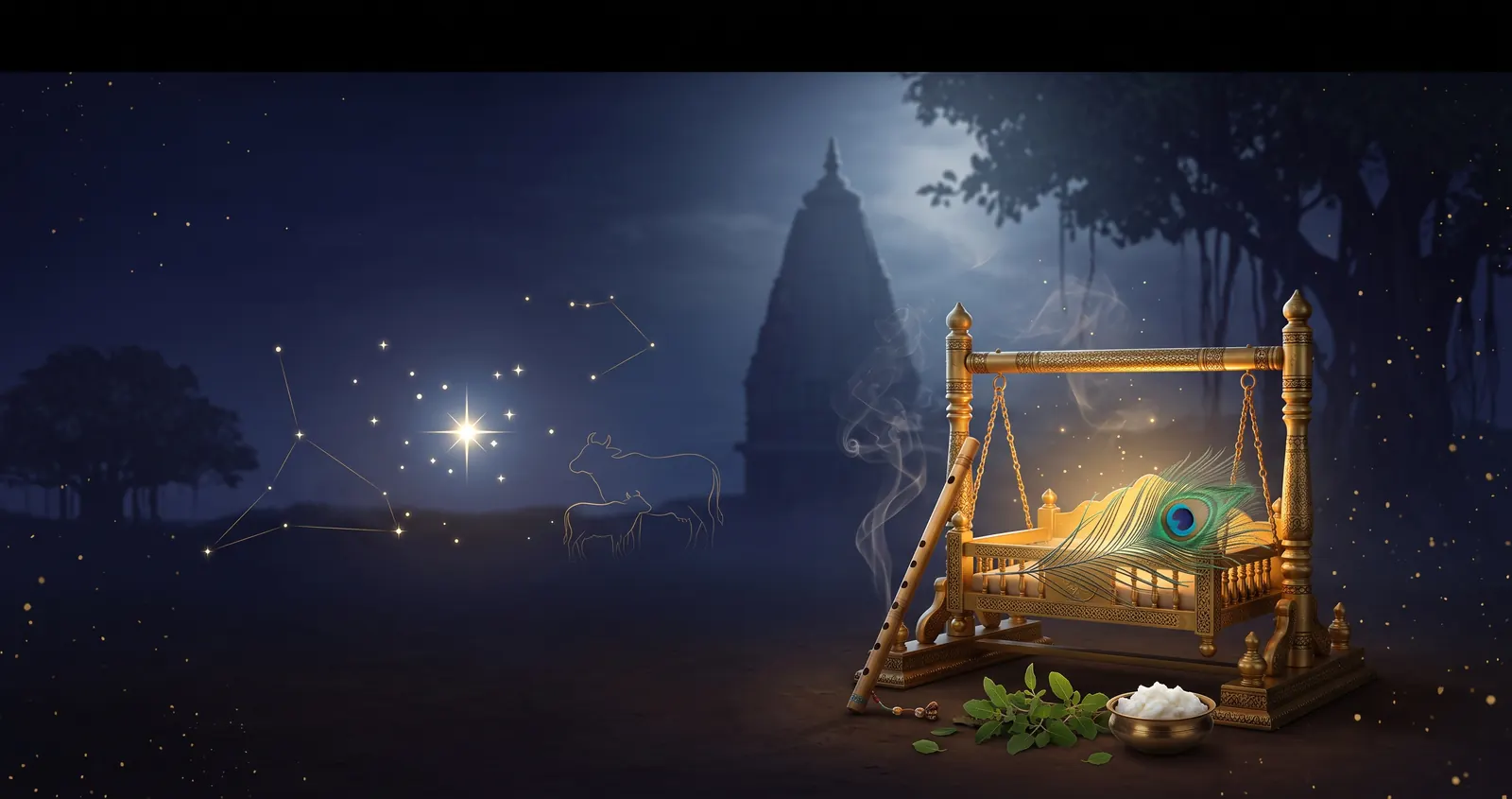
Janmashtami is a nirjala or phalahari fast for most observers - many take no grains, only fruit and milk products, until the Nishita Puja is complete. The idol of Bal Gopal (infant Krishna) is bathed, dressed and placed in a decorated cradle (jhoola) at midnight, and the fast is broken only after this abhishekam and aarti.
- MorningSankalp (intention-setting) and a light fast begins; many clean and decorate a small altar or cradle for Bal Gopal
- EveningRecitation of the Krishna Janma Katha, bhajans and kirtan build toward midnight
- Nishita Kaal (~12:14 AM - 1:01 AM)Abhishekam of the Bal Gopal idol with panchamrit, followed by dressing, cradling and aarti
- OfferingsMakhan-mishri (butter and sugar), panjiri, and Krishna's favoured foods are offered and later distributed as prasad
- Fast-breakingAfter the midnight puja, most observers break their fast with prasad
- Dahi HandiCelebrated the day after Janmashtami in Maharashtra and parts of Gujarat, re-enacting young Krishna's playful butter theft with human pyramids breaking a suspended curd pot
What This Festival Teaches About Timing in Your Own Chart
There is a quieter astrological lesson inside this year's date confusion. Krishna's birth chart itself is one of the most extensively debated in classical Jyotish precisely because of how sensitive planetary placements are to exact birth time - a matter of minutes shifts the Ascendant, the house lord placements and, ultimately, the entire predictive reading. The very fact that Ashtami and Rohini overlap for barely twenty minutes this year is a live demonstration of why astrologers insist on exact birth time before drawing conclusions from any chart, divine or human.
This is the same principle behind Muhurat Shastra more broadly: an auspicious window is not a full day but a precise slice of it, and acting inside versus just outside that slice can matter. If your own birth time was recorded loosely - 'around evening' or 'sometime after lunch' - your Lagna and house placements may be resting on a foundation as uncertain as this year's Janmashtami date debate.
The takeaway
Krishna Janmashtami 2026 is best understood not as a dispute but as two traditions correctly reading the same sky through different priorities - Smarta households on September 4, Vaishnava and temple traditions on September 5, with the Nishita Puja Muhurat falling around 12:14 AM to 1:01 AM on the night between them. Beyond the calendar, Rohini Nakshatra itself - the Moon's most cherished star, the seat of beauty, growth and material abundance - offers a lens on charisma, attachment and prosperity that outlasts any single festival night. If this year's date puzzle has you wondering how precisely timing shapes a chart, that same sensitivity governs your own Janam Kundali. Book a 1-on-1 video consultation with Astrologer Sheela Goklani to get an accurate Lagna reading, Rohini or any other nakshatra's influence on your Moon, and personalised remedies for the year ahead.
Book a consultation