In short
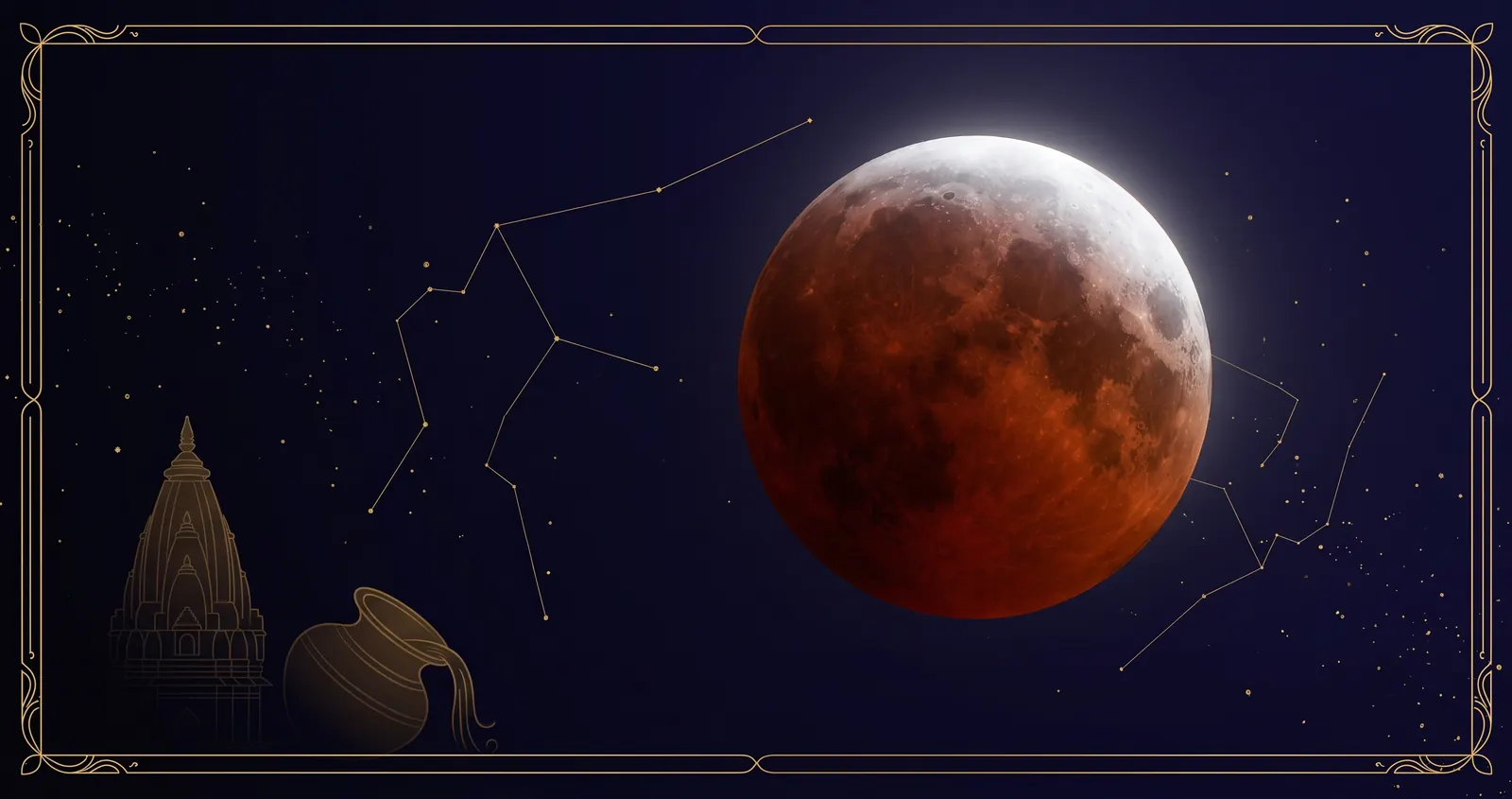
A partial lunar eclipse falls on August 28, 2026 in Aquarius (Kumbh Rashi) and Shatabhisha Nakshatra, the same day as Raksha Bandhan. It is not visible from India, so no Sutak Kaal applies and rakhi rituals proceed normally. Here are the exact timings, rashi-wise effects, and Vedic remedies.
On Friday, August 28, 2026, the second lunar eclipse of the year - a deep partial Chandra Grahan - unfolds in the sidereal sign of Aquarius (Kumbh Rashi) within Shatabhisha Nakshatra, while the eclipsed Full Moon stands opposite the Sun in Leo (Simha Rashi) in Magha Nakshatra. Because the same date carries Raksha Bandhan, millions of families across India are asking one urgent question: will Sutak Kaal cancel the rakhi muhurat? The short answer is no. This eclipse is not visible from any part of India - the Moon remains below the Indian horizon for its entire duration - and in classical Vedic practice Sutak is observed only where an eclipse is physically visible. In this guide, astrologer Sheela Goklani explains the exact IST timings, why Shatabhisha makes this particular grahan a healing and revelation event rather than a destructive one, how the eclipse axis interacts with Rahu in Aquarius and Ketu in Leo, what each of the twelve Moon signs should expect over the next six months, and the specific remedies that convert eclipse pressure into karmic clearance.
Is Sutak Kaal Applicable for the 28 August 2026 Lunar Eclipse in India?
No. Sutak Kaal does not apply anywhere in India for this eclipse. The grahan occurs during Indian daytime hours while the Moon is below the horizon, which means it cannot be seen from Delhi, Mumbai, Ahmedabad, Kolkata, Chennai, Bengaluru or any other Indian city. Classical Dharmashastra and Panchang convention are consistent on this point: an eclipse that is not visible (adrishya grahan) at a given location generates no Sutak obligations there.
Practically, this means temples remain open, cooking and eating continue as usual, pregnant women face no ritual restrictions, idols need not be covered, and no post-eclipse purification bath is required in India. The astrological influence of the eclipse on your birth chart still operates - visibility governs ritual observance, not planetary effect - but the household rules that normally accompany a grahan simply do not switch on this time.
- Eclipse dateFriday, August 28, 2026
- TypeDeep partial lunar eclipse (Khandagras Chandra Grahan)
- Penumbral phase beginsapproximately 6:54 AM IST
- Partial phase beginsapproximately 8:04 AM IST
- Maximum eclipseapproximately 9:43 AM IST
- Partial phase endsapproximately 11:22 AM IST
- Penumbral phase endsapproximately 12:32 PM IST
- Visibility in IndiaNot visible - Moon below the horizon throughout
- Sutak Kaal in IndiaNot applicable
Can Raksha Bandhan Be Celebrated Normally on August 28, 2026?
Yes. Raksha Bandhan 2026 falls on Friday, August 28, and the rakhi ceremony can be performed without any eclipse-related restriction. Two factors make this year unusually clean from a Panchang standpoint. First, no Sutak applies because the grahan is invisible in India. Second, Bhadra - the inauspicious karana that normally forces sisters to wait until afternoon - concludes before sunrise, leaving the entire morning open for the ritual.
The most auspicious window for tying the rakhi runs roughly from 5:57 AM to 9:48 AM IST, with the Aparahna period of approximately 1:30 PM to 4:00 PM IST serving as a secondary muhurat for families who cannot complete the ceremony in the morning. City-level sunrise differences of ten to twenty-five minutes apply, so confirm against your local Panchang.
An eclipse you cannot see does not bind your rituals - but it still stirs the chart you were born with. Observe the festival with joy; observe your inner life with attention.
Why Shatabhisha Nakshatra Makes This Grahan a Healing Eclipse
Shatabhisha spans 6°40' to 20°00' of Aquarius and translates as 'the hundred healers' or 'the hundred physicians.' Its ruling deity is Varuna, the Vedic lord of cosmic waters, oaths and hidden law, and its planetary lord is Rahu himself. The symbol is an empty circle - a boundary, a veil, a protective enclosure that conceals something powerful within.
When a lunar eclipse - already a Rahu-Ketu phenomenon - lands inside a Rahu-ruled nakshatra, the veiling theme doubles. This is why the 28 August grahan is best read not as a destruction event but as a disclosure event: sealed information surfaces, secrets held for years lose their protective circle, chronic health issues finally receive a correct diagnosis, and long-buried emotional material rises for treatment. Shatabhisha rules medicine, research, astrology, electricity, technology, aviation and large collective systems, so revelations in exactly these sectors are favoured.
The opposing Sun sits in Magha Nakshatra in Leo alongside Ketu. Magha is the star of ancestry, thrones and lineage. With the luminaries split between an ancestral fire nakshatra and a healing air nakshatra, the eclipse axis asks a precise question: which inherited role are you still performing out of duty, and which one is genuinely yours?
- Eclipsed MoonAquarius (Kumbh Rashi), Shatabhisha Nakshatra, lord Rahu, deity Varuna
- Opposing SunLeo (Simha Rashi), Magha Nakshatra, lord Ketu, deity the Pitrs
- Nodal backdropRahu transiting Aquarius, Ketu transiting Leo until the axis shifts to Capricorn-Cancer on December 5, 2026
- Core themesDiagnosis and healing, whistleblowing and disclosure, technology and research breakthroughs, detachment from inherited identity
Effects of the 28 August 2026 Lunar Eclipse on All 12 Rashis
Read the following by your Moon sign (Chandra Rashi) first and your Ascendant (Lagna) second. Eclipse results typically unfold over the following six months rather than on the day itself, peaking whenever a fast-moving planet later crosses the eclipse degree in early-to-mid Aquarius.
- Aries (Mesha)Eleventh house eclipse. Friend circles and professional networks reorganise; an income stream tied to a group, platform or community either transforms or ends. Audit long-pending dues.
- Taurus (Vrishabha)Tenth house eclipse. Career visibility spikes suddenly. A reporting line, employer or public reputation matter reaches a decisive turn - avoid resigning impulsively before mid-September.
- Gemini (Mithuna)Ninth house eclipse. Beliefs, gurus, higher study and foreign travel plans come under review. Favourable for research admissions and visa outcomes; unfavourable for blind faith in advisors.
- Cancer (Karka)Eighth house eclipse. Joint finances, insurance, inheritance and intimate trust are exposed. Handle with care: verify documents, avoid new loans, prioritise sleep and emotional support.
- Leo (Simha)Seventh house eclipse with the Sun and Ketu on your own sign. Partnerships - marital and business - demand honesty. Something you were maintaining for appearances is likely to release.
- Virgo (Kanya)Sixth house eclipse. Excellent for defeating a chronic problem: debt restructuring, court matters, workplace rivals or a long-standing health complaint finally receives its correct remedy.
- Libra (Tula)Fifth house eclipse. Children, creativity, speculation and romance move to a turning point. Avoid leveraged trading; channel the energy into a creative project or a fertility or education decision.
- Scorpio (Vrischika)Fourth house eclipse. Home, property, vehicles and the mother's wellbeing become focal. Property paperwork and relocation decisions benefit from delay until after mid-September.
- Sagittarius (Dhanu)Third house eclipse. Communication, siblings, short travel and courage are activated. A message you finally send - or finally stop sending - changes a relationship's direction.
- Capricorn (Makara)Second house eclipse. Savings, family wealth, speech and food habits are under review. Restructure budgets now; the December Rahu-Ketu shift into your sign makes this preparation valuable.
- Aquarius (Kumbh)First house eclipse directly over your rashi. The most personal impact of all: identity, appearance, health and self-definition reset. Rest, avoid confrontation, and let an outdated self-image dissolve.
- Pisces (Meena)Twelfth house eclipse. Expenses, foreign matters, hospitals, sleep and spiritual practice dominate. Superb for retreat, meditation and closure; poor for large discretionary spending.
The Six-Month Eclipse Window: When Effects Actually Arrive
One of the most common misconceptions is that an eclipse delivers its results on the eclipse day. In practical Jyotish, the eclipse plants a seed at a specific degree of the zodiac, and the seed germinates whenever that degree is later triggered.
For the 28 August grahan, the sensitive point sits in early-to-mid Aquarius. Watch the weeks when the Sun, Mars, Mercury or Venus transit that zone, and watch the period around the Rahu-Ketu axis change on December 5, 2026, when the nodes leave Aquarius-Leo for Capricorn-Cancer. That ingress will re-trigger everything this eclipse touched. The full arc runs until the next eclipse season in February 2027.
- Immediate window (Aug 28 - Sep 11, 2026)Emotional volatility, revelations, sudden clarity. Decide nothing irreversible.
- Activation window (Sep - Nov 2026)Fast planets cross the eclipse degree; concrete events replace vague unease.
- Re-trigger point (December 5, 2026)Rahu and Ketu shift to Capricorn-Cancer, reopening eclipse themes at a deeper level.
- Closure window (up to February 2027)The next eclipse season resets the axis and completes the story.
Vedic Remedies for the Shatabhisha Lunar Eclipse
Because no Sutak applies in India, remedies here are voluntary spiritual practices rather than mandatory purification rules. Their purpose is to strengthen the Moon (Chandra), pacify Rahu, and honour the Pitrs indicated by the Sun in Magha - which is especially timely, since Pitru Paksha begins less than a month later on September 26, 2026.
- Chant the Chandra Beej MantraRecite 'Om Shram Shreem Shroum Sah Chandramase Namah' 108 times to stabilise the eclipsed Moon and calm mental restlessness.
- Recite the Maha Mrityunjaya MantraShatabhisha's healing signature responds strongly to Lord Shiva's mantra; 11 or 108 repetitions on eclipse day supports physical and psychological recovery.
- Pacify Rahu with Durga worshipOffer coconut, blue or dark blue flowers, and light a mustard-oil lamp on Saturday evening. Chanting 'Om Bhram Bhreem Bhroum Sah Rahave Namah' is the classical Rahu beej mantra.
- Donate water and medicineVaruna rules water and Shatabhisha rules medicine. Sponsoring clean drinking water, donating medicines to a charitable clinic, or funding a patient's treatment is the single most aligned charity for this eclipse.
- Offer Tarpan to ancestorsWith the Sun in Magha beside Ketu, water offerings to the Pitrs release lineage-level blockages and prepare the ground for Pitru Paksha.
- Fast lightly and eat sattvic foodA simple fruit-and-milk day supports the Moon even where Sutak rules do not apply.
The takeaway
The Chandra Grahan of August 28, 2026 arrives without Sutak in India, leaves Raksha Bandhan completely unobstructed, and carries a fundamentally constructive signature: Shatabhisha, the star of a hundred healers, presiding over an eclipse that lifts veils rather than tears things down. Celebrate the festival fully, then use the six months that follow to act on whatever this eclipse reveals - a diagnosis, a truth, a relationship pattern, a career direction. To learn exactly which house of your Janam Kundali carries the eclipse degree, whether your current Vimshottari Dasha amplifies or cushions it, and which remedies suit your chart specifically, book a personal 1-on-1 video consultation with Astrologer Sheela Goklani.
Book a consultation