In short
A Vedic astrology (Jyotish) reading is a live conversation in which an astrologer reads your sidereal birth chart - your rising sign, Moon sign and the planetary period you are in - and answers your questions with timing. Here is what it covers, what to have ready, how an online session works from the USA, UK, Canada, Australia or Europe, and what a reading cannot do.
- What it reads
- Your sidereal birth chart: rising sign (Lagna), Moon sign, houses and your running planetary period (Dasha)
- What you need
- Date, exact time and place of birth, as written on your birth record
- Format
- Live one-to-one video call on Google Meet; slots shown in your own time zone
- Language
- English, or Hindi, Gujarati, Rajasthani, Sindhi or Urdu
- Background needed
- None - terms are explained as the reading goes
A Vedic astrology reading is a live conversation about your birth chart, cast in the sidereal zodiac that Indian astrology (Jyotish) has always used. Where a Western reading usually starts from your Sun sign and the psychology of the chart, a Vedic reading starts from your rising sign (the Lagna), your Moon sign and the planetary period - the Dasha - you are living through right now, and it leans towards timing: when a stretch eases, when a move is supported, which years to push and which to consolidate. You do not need to be Indian, Hindu or familiar with any Sanskrit to book one. This guide explains what is read, what to prepare, how an online session works from another time zone and what a good reading will not promise.
What a Vedic Astrology Reading Actually Reads
The astrologer works from your Janam Kundali, the natal chart calculated for the minute and place of your birth. Because Jyotish measures the zodiac against the stars rather than the seasons, your placements usually sit one sign earlier than in a Western chart - a Western Leo is often a Vedic Cancer. That is expected, and the reading explains it.
From the chart, a Vedic astrologer looks first at a handful of things that have no exact equivalent in a Sun-sign horoscope:
- Lagna (Ascendant / rising sign)the sign rising at birth; it fixes the twelve houses and therefore which part of life each planet runs
- Rashi (Moon sign) and Nakshatrathe Moon's sign and its lunar mansion, one of 27; Jyotish reads the mind, and most transits, from the Moon
- Vimshottari Dashathe planetary period you are in - a timeline of Mahadashas lasting 6 to 20 years each, divided into sub-periods - which is how a Vedic reading dates events
- Transits (Gochara)where slow planets such as Saturn, Jupiter and the lunar nodes Rahu and Ketu are moving now, read from your Moon and Ascendant
- Divisional chartsthe Navamsa (D9) for marriage and inner strength, the Dashamsa (D10) for career
How It Differs From a Western Astrology Reading
Western astrology, especially in its modern psychological form, is excellent at describing temperament and inner patterns. Jyotish describes those too, but its distinctive strength is prediction: the Dasha system lets the astrologer say not only what the chart promises but roughly when it is likely to come to the surface. A strong career indication matures in the period of the planet that carries it; a hard stretch has a start and an end.
There are practical differences as well. A Vedic chart is drawn as a square (North or South Indian style), not a wheel; houses are usually whole signs counted from the Ascendant; Uranus, Neptune and Pluto are not traditionally used; and the Moon matters at least as much as the Sun. If you already know your Western chart, bring it along - comparing the two is often illuminating, and the differences are explained rather than glossed over.
What to Prepare Before Your Session
The single most important thing is an accurate birth time. The rising sign changes roughly every two hours, and every house is counted from it. Give the time exactly as written on your birth certificate or hospital record, with the town or city of birth. Do not convert it to Indian time: the chart is calculated with the time zone and daylight-saving rule that applied where you were born, on that date.
Then decide what you most want to know. A reading is more useful when it is anchored to real questions than when it tries to cover everything at once.
- Birth datadate, exact time (to the minute if you have it) and town of birth
- Two to four questionsfor example, is this a good year to change jobs, why does this relationship keep stalling, when does this difficult period ease
- Context that helpsthe dates of a few major past events (a move, a marriage, a job change) let the astrologer check the chart against your life, and are essential if your birth time is uncertain
- Optionalyour Western chart, if you know it, and the result of a free calculator - your Vedic Moon sign or running Dasha - so you arrive with the vocabulary
How an Online Session Works Across Time Zones
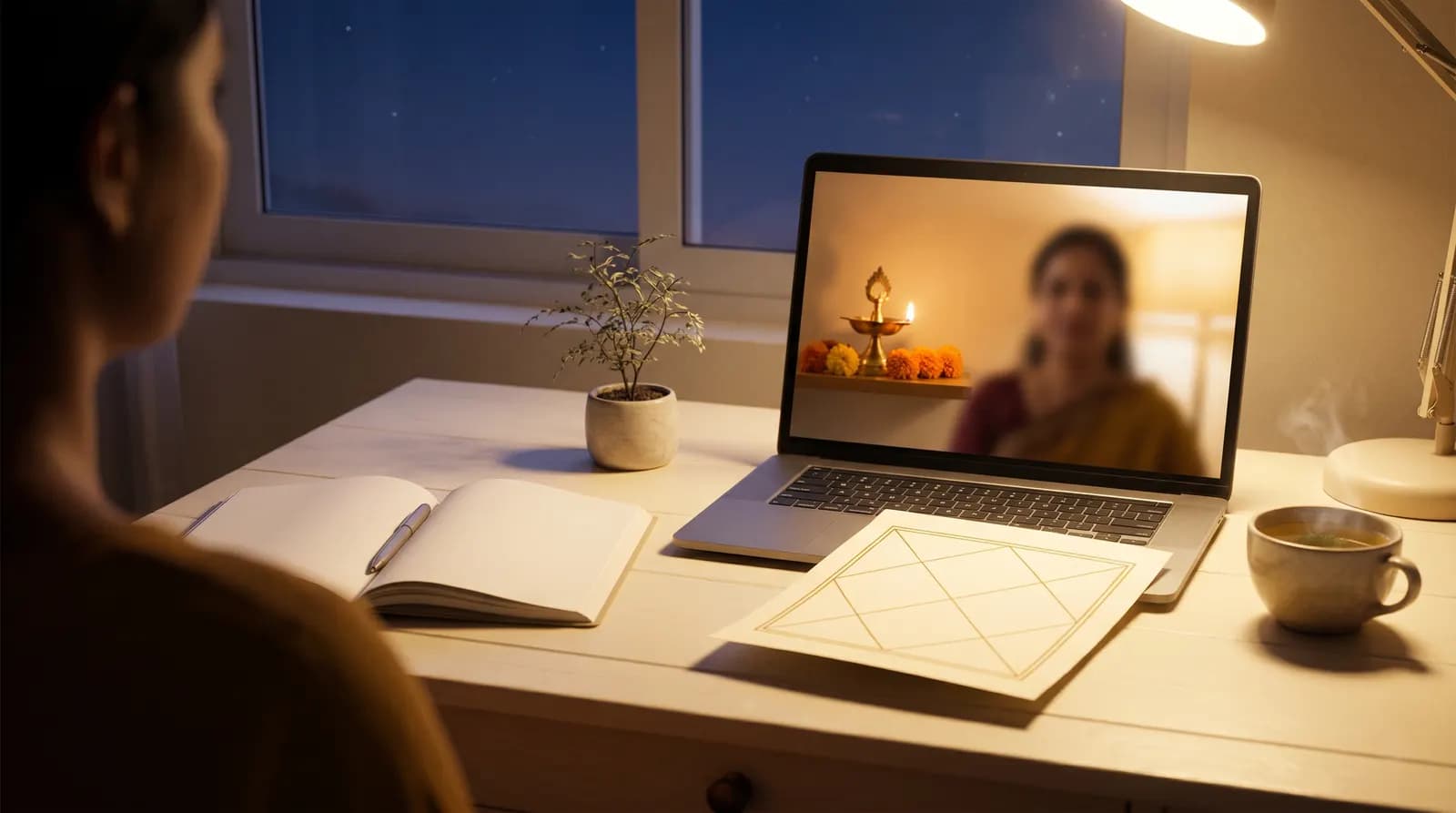
Sessions are one-to-one live video calls on Google Meet, which runs in a browser with no software to install. The booking calendar converts every open slot into the time zone your device reports, so the time you pick is your local time in New York, Toronto, London, Berlin or Sydney, and the Google Calendar invite shows the same. India does not use daylight saving, so the gap with you changes when your clocks do; the calendar handles that for you.
Payment is taken when you book, by international card, and the slot is held for you once it is paid. If something comes up, rescheduling is free up to 24 hours before the session. Readings are in English, and also in Hindi, Gujarati, Rajasthani, Sindhi or Urdu if you or a family member would prefer that.
The session itself is live. There is no pre-recorded video and no written report sent in place of the conversation, so keep a notebook beside you. Sessions are not recorded.
Remedies: What They Are and Whether You Need Them
Jyotish traditionally pairs a reading with upayas, or remedies: a mantra, a regular act of charity, a weekday fast, a simple discipline connected with the planet that needs support. Gemstones are a remedy too, but a careful astrologer recommends one only when the chart genuinely warrants it, never by default.
Remedies are suggestions, not conditions. If devotional practices are not part of your life, say so; the practical side of a reading - timing, and an honest description of your strengths and pressure points - stands on its own.
What a Reading Can and Cannot Do
Vedic astrology describes tendencies and timing windows: when conditions favour a move, when patience pays more than force, how two people's charts interact. It does not fix outcomes, and an astrologer who promises certainty should be treated with caution. Your choices inside those windows remain yours.
A reading is also not a substitute for medical, legal, immigration or financial advice. It can help you think about timing and priorities around those decisions, alongside the professionals who handle them.
The takeaway
A Vedic astrology reading reads your sidereal chart - rising sign, Moon sign and Nakshatra, and the Dasha you are in - and turns it into timing for the questions you bring. Have your exact birth time and town ready, pick two to four questions, and book a slot in your own time zone on Google Meet. If you would like to see your chart first, the free birth chart and Dasha calculators show the same placements the reading starts from.
Ask One Question