
In short
On Monday, August 2, 2027 the Moon's shadow crosses southern Spain, North Africa, Egypt and Arabia - over six minutes of totality near Luxor - and a partial eclipse is visible from all of India in the late afternoon, so Sutak is kept. It falls on Shravana Amavasya, with the Sun and Moon in Cancer (Karka) and Pushya nakshatra.
- Date
- Monday, August 2, 2027 - Shravana Amavasya
- Type
- Total; partial from India
- Greatest eclipse
- 3:36 PM IST (10:06 UTC), near Luxor, Egypt
- Delhi
- 3:53 PM to 5:02 PM IST, maximum 4:29 PM (8% of the Sun covered)
- Mumbai
- 3:47 PM to 5:31 PM IST, maximum 4:41 PM (32%)
- Sutak in India
- From about 12 hours before the eclipse starts in your city
- Vedic placement
- Sun and Moon in Karka (Cancer) 16°, Pushya nakshatra, with Ketu
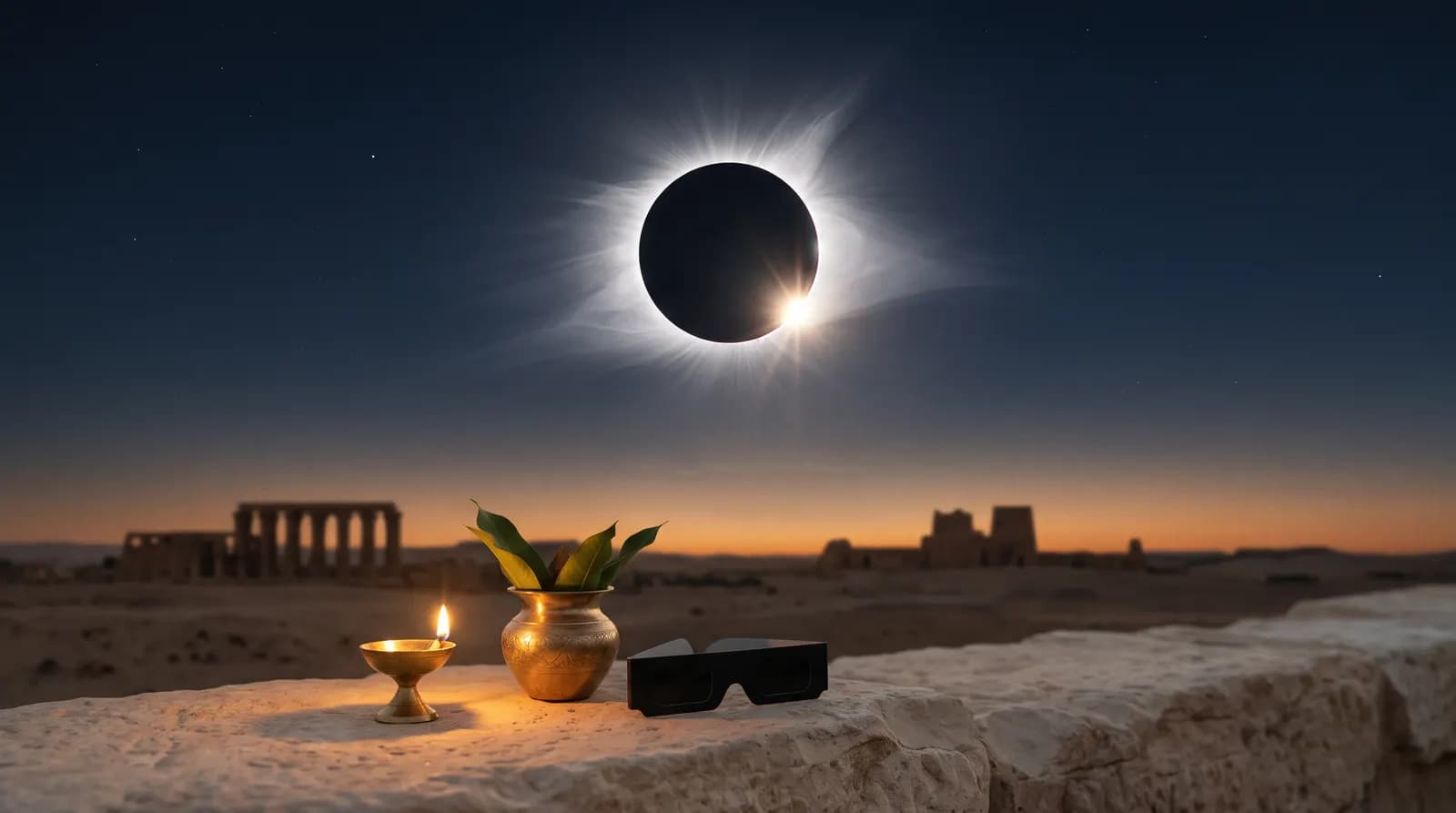
The total solar eclipse of August 2, 2027 is one of the longest of the century: the Moon's shadow runs from the Atlantic across southern Spain and Gibraltar, Morocco, Algeria, Tunisia, Libya and Egypt into Saudi Arabia and Yemen, with totality lasting over six minutes near Luxor. India is outside the path of totality but sees a partial eclipse everywhere in the late afternoon - so, unlike February's eclipse, Sutak and the eclipse observances apply across India.
Is the August 2, 2027 solar eclipse visible in India?
Yes, as a partial eclipse in the late afternoon of Monday, August 2. The south and west of India see more of it: about a third of the Sun's disc is covered in Mumbai, Chennai and Bengaluru, a quarter in Ahmedabad, and less than a tenth in Delhi and Kolkata.
| City | Begins | Maximum | Ends | Sun covered (area) |
|---|---|---|---|---|
| New Delhi | 3:53 PM | 4:29 PM | 5:02 PM | 8% |
| Mumbai | 3:47 PM | 4:41 PM | 5:31 PM | 32% |
| Ahmedabad | 3:44 PM | 4:35 PM | 5:21 PM | 24% |
| Kolkata | 4:14 PM | 4:43 PM | 5:11 PM | 6% |
| Chennai | 4:02 PM | 4:54 PM | 5:41 PM | 34% |
| Bengaluru | 3:58 PM | 4:53 PM | 5:43 PM | 39% |
Where is the August 2027 eclipse total, and what do NRIs see?
Totality crosses southern Spain (Cádiz, Málaga, Gibraltar), northern Morocco (Tangier), Libya (Benghazi, Tripoli), Egypt (Luxor, the longest at over six minutes), Saudi Arabia (Jeddah and Mecca) and Yemen. Europe, the Gulf and East Africa see a deep partial eclipse. It is not visible from North or South America, Australia, New Zealand or southern Africa.
| City | Type | Sun covered (area) | Begins | Maximum | Ends |
|---|---|---|---|---|---|
| Jeddah | Total (about 6 min) | 100% | 12:00 PM | 1:25 PM | 2:43 PM |
| Luxor | Total (over 6 min) | 100% | 11:40 AM | 1:05 PM | 2:26 PM |
| Tangier | Total | 100% | 8:40 AM | 9:46 AM | 11:00 AM |
| Cairo | Partial | 95% | 11:33 AM | 12:55 PM | 2:16 PM |
| Riyadh | Partial | 76% | 12:13 PM | 1:32 PM | 2:44 PM |
| Doha | Partial | 62% | 12:24 PM | 1:38 PM | 2:46 PM |
| Dubai | Partial | 53% | 1:33 PM | 2:43 PM | 3:47 PM |
| Muscat | Partial | 50% | 1:42 PM | 2:50 PM | 3:52 PM |
| Madrid | Partial | 86% | 9:45 AM | 10:51 AM | 12:02 PM |
| Paris | Partial | 51% | 10:00 AM | 11:01 AM | 12:04 PM |
| Frankfurt | Partial | 44% | 10:08 AM | 11:08 AM | 12:10 PM |
| London | Partial | 42% | 9:03 AM | 10:00 AM | 10:59 AM |
| Leicester | Partial | 38% | 9:05 AM | 9:59 AM | 10:57 AM |
| Dublin | Partial | 36% | 9:03 AM | 9:56 AM | 10:51 AM |
| Nairobi | Partial | 31% | 12:52 PM | 2:01 PM | 3:04 PM |
| Port Louis | Partial | 24% | 2:53 PM | 3:44 PM | 4:31 PM |
| Singapore | Partial at sunset | Sets eclipsed | 6:52 PM | - | - |
| USA, Canada, Australia | Not visible | - | - | - | - |
What is the Sutak time for the August 2027 solar eclipse?
Sutak for a solar eclipse traditionally begins four prahars - about 12 hours - before the eclipse starts at your location and ends when it ends. In Delhi that is from about 3:53 AM to 5:02 PM IST on August 2; in Mumbai from about 3:47 AM to 5:31 PM. During Sutak temples close, cooking and eating are traditionally avoided (with allowances for children, the elderly and the unwell), and japa, prayer and charity are encouraged; a bath after the eclipse ends closes the observance. Sutak applies wherever the eclipse is visible - including the UK, Europe, the Gulf and East Africa - and not in the Americas or Australia.
Never look at the Sun during any phase of a partial or annular eclipse without certified solar-viewing glasses (ISO 12312-2) or a pinhole projector - ordinary sunglasses, phone screens and X-ray film do not protect your eyes.
What does the August 2027 solar eclipse mean in Vedic astrology?
The Sun and Moon meet at about 16° of sidereal Cancer (Karka), in Pushya nakshatra, with Ketu in Cancer and Rahu opposite in Capricorn after the December 2026 nodal shift. Cancer is the Moon's own sign - home, mother, emotional security - and Pushya, ruled by Saturn and presided over by Brihaspati, is the most nourishing of the nakshatras. Classical readings point to themes of home, food, public welfare and care-giving coming under strain and review. Moon signs for which Cancer is the 1st, 4th, 7th, 8th or 12th house - Karka, Mesha, Makara, Dhanu and Simha - traditionally take the most care; people with the Sun, Moon or Lagna near 16° Cancer or Capricorn feel it most.
Eclipses are read as turning points rather than misfortunes. The practical advice is simple: avoid starting major ventures on the day, spend the Sutak quietly, and give charity - especially food - after the eclipse ends.
The takeaway
The August 2, 2027 total solar eclipse is partially visible across India from about 3:45 to 5:45 PM IST, so Sutak is kept from roughly 12 hours before your city's start time. Totality - over six minutes near Luxor - crosses southern Spain, North Africa, Egypt and Arabia, and Europe and the Gulf see a deep partial eclipse. It falls on Shravana Amavasya in Cancer and Pushya with Ketu. Watch only with certified eclipse glasses.
Book a Dasha Analysis