In short
The annular 'ring of fire' eclipse of February 6, 2027 falls on Mauni Amavasya, with the Sun in Capricorn and the Moon in Dhanishta. It is not visible from India, the UK, North America, the Gulf or Australia, so no Sutak applies there; it is seen from Argentina, Uruguay, southern Brazil and, at sunset, West Africa.
- Date
- Saturday, February 6, 2027 - Mauni (Magha) Amavasya
- Type
- Annular ('ring of fire')
- Greatest eclipse
- 9:29 PM IST (15:59 UTC), over the South Atlantic
- Visible in India?
- No - so no Sutak in India
- Seen from
- Argentina, Uruguay, southern Brazil, Chile (partial); West Africa at sunset
- Vedic placement
- Sun in Makara (Capricorn) 23°, Moon in Dhanishta nakshatra
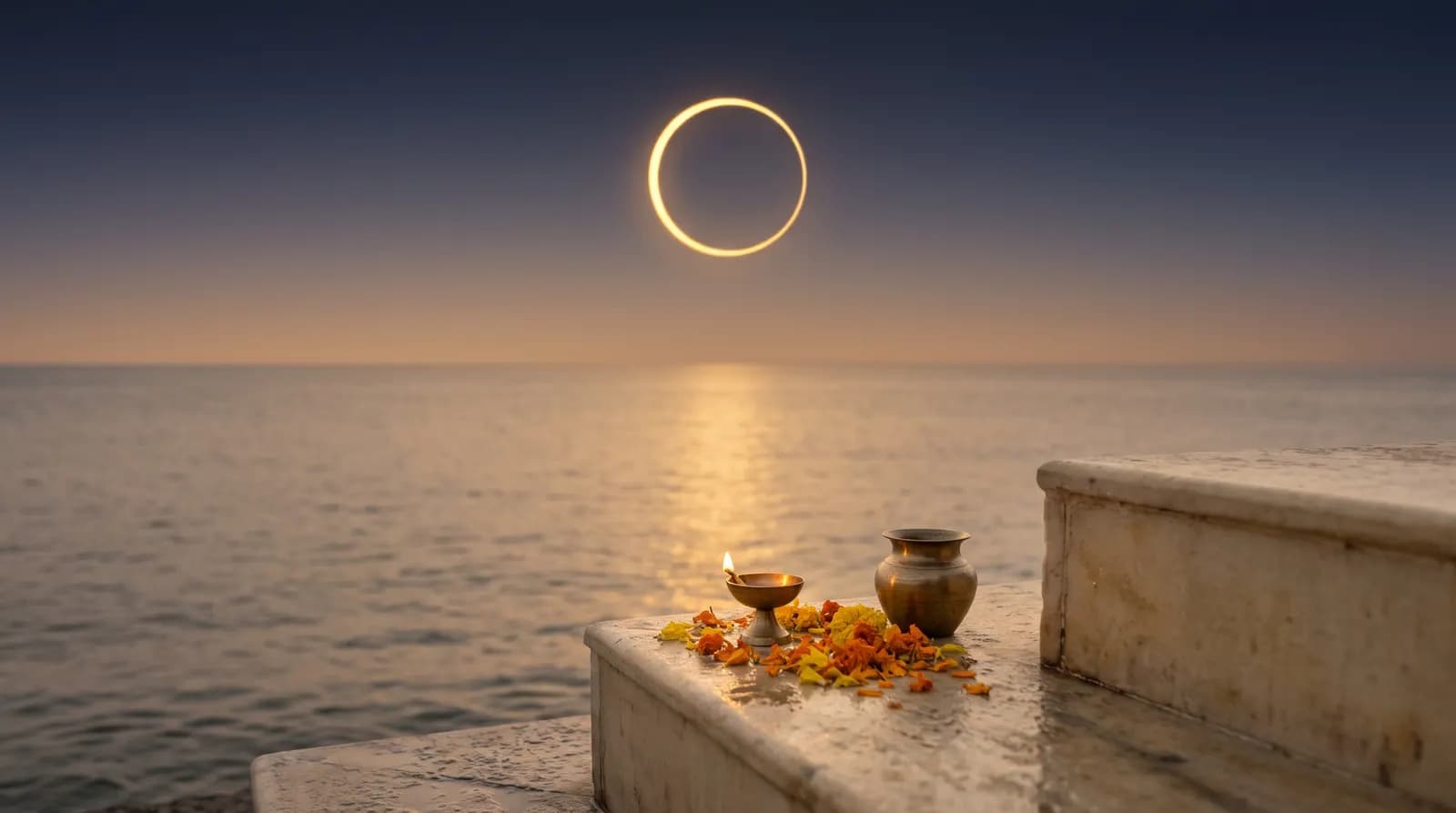
The first solar eclipse of 2027 is annular - the Moon too far from Earth to cover the Sun completely, leaving a bright ring - and it falls on Saturday, February 6, the Magha Amavasya kept as Mauni Amavasya. Greatest eclipse is at 9:29 PM IST over the South Atlantic. It cannot be seen from India, so the Sutak period and eclipse restrictions do not apply there; the holy dip and silence of Mauni Amavasya go ahead as usual.
Is the February 6, 2027 solar eclipse visible in India?
No. The eclipse happens in India's late evening, after sunset, and the Moon's shadow falls on the Southern Hemisphere. It is also not visible from the UK, Europe, North America, the Gulf, Singapore, Australia or New Zealand.
Where can the annular eclipse be seen?
The ring of fire crosses Argentina - Bahía Blanca and Mar del Plata are in the path - then the South Atlantic, ending at sunset over West Africa (Côte d'Ivoire, Ghana, Togo, Benin and Nigeria, with the Sun very low). Much of South America sees a deep partial eclipse.
| Place | Type | Sun covered (area) | Begins | Maximum | Ends |
|---|---|---|---|---|---|
| Buenos Aires | Partial | 82% | 10:46 AM | 12:31 PM | 2:15 PM |
| Santiago | Partial | 62% | 10:26 AM | 12:04 PM | 1:48 PM |
| Accra | Annular at sunset | 84% | 4:41 PM | 5:52 PM | Sets eclipsed |
| Lagos | Annular at sunset | 84% | 5:44 PM | 6:52 PM | Sets eclipsed |
| Paramaribo | Partial | 3% | 1:29 PM | 2:16 PM | 2:59 PM |
| Johannesburg | Partial at sunset | 6% | 6:36 PM | Below horizon | - |
| India, UK, USA, Gulf, Australia | Not visible | - | - | - | - |
Is there Sutak for the February 2027 eclipse?
Not in India or anywhere the eclipse is not seen. By the standard Panchang rule, Sutak - the 12 hours before a solar eclipse when temples close and cooking and eating are traditionally avoided - applies only where the eclipse is visible. Families in Argentina, Uruguay, southern Brazil or West Africa who follow the custom would count it from the local start time.
Never look at the Sun during any phase of a partial or annular eclipse without certified solar-viewing glasses (ISO 12312-2) or a pinhole projector - ordinary sunglasses, phone screens and X-ray film do not protect your eyes.
What does the February 2027 eclipse mean in Vedic astrology?
The Sun and Moon meet at about 23° of sidereal Capricorn (Makara), in Dhanishta nakshatra, close to Rahu, which moves into Capricorn in December 2026. Classical texts read eclipses through the sign and nakshatra they fall in: Capricorn is Saturn's sign of work, structure and public duty, and Dhanishta is the nakshatra of rhythm, wealth and group effort. Moon signs for which Capricorn is the 1st, 4th, 7th, 8th or 12th house - Makara, Tula, Karka, Mithuna and Kumbha - traditionally take the most care; for others it passes lightly.
Because the eclipse is not visible from India, many astrologers give it a muted weight there. Mauni Amavasya's own observances - silence, a holy dip, charity and remembrance of ancestors - are unaffected.
The takeaway
The February 6, 2027 annular solar eclipse falls on Mauni Amavasya, peaks at 9:29 PM IST over the South Atlantic and is not visible from India, so no Sutak is kept there. It is seen from southern South America and, at sunset, West Africa. Its Vedic placement is Capricorn and Dhanishta, near Rahu. The bigger event of the year is the total eclipse of August 2, 2027, which is visible across India.
Ask One Question