In short
Pitru Paksha 2026 runs from Saturday, 26 September to Saturday, 10 October 2026, ending on Sarva Pitru Amavasya. Get the complete day-by-day Shradh tithi calendar, the correct Tarpan and Pind Daan procedure, symptoms of Pitra Dosha in a Janam Kundali, and what to avoid during these 15 days.
Pitru Paksha - the fifteen-day lunar fortnight dedicated to the ancestors - begins on Saturday, September 26, 2026 with Purnima Shradh and concludes on Saturday, October 10, 2026 with Sarva Pitru Amavasya, also called Mahalaya Amavasya. In Sanatana Dharma this period is not mourning; it is Pitru Rin, the repayment of ancestral debt, one of the three fundamental debts every human being is said to carry. Vedic astrology treats it with equal seriousness, because an afflicted ninth house, a Sun-Ketu or Sun-Rahu combination, or planets caught between the nodes can indicate Pitra Dosha - a karmic blockage inherited through the lineage that quietly obstructs childbirth, marriage, property and career progress. In this complete guide, Astrologer Sheela Goklani provides the day-by-day Shradh tithi calendar for 2026, the correct method of Tarpan and Pind Daan, the astrological markers of Pitra Dosha in a birth chart, and the rules that must be observed during these fifteen days.
When Is Pitru Paksha 2026? Exact Start and End Dates
Pitru Paksha 2026 spans Saturday, September 26 to Saturday, October 10, 2026. It occupies the Krishna Paksha - the waning fortnight - of the lunar month of Bhadrapada, beginning immediately after Bhadrapada Purnima and ending at Ashwin Amavasya.
The fortnight opens with Purnima Shradh and closes with Sarva Pitru Amavasya on October 10, 2026, the single most important day of the entire period. Sarva Pitru Amavasya is the universal remedy day: any ancestor whose exact tithi of passing is unknown, or whose Shradh was missed on its correct day, can be honoured on this date. Immediately after Pitru Paksha closes, the auspicious season resumes with Sharad Navratri beginning on October 11, 2026 and Vijayadashami on October 20, 2026.
- Pitru Paksha 2026 beginsSaturday, September 26, 2026 (Purnima Shradh)
- Pitru Paksha 2026 endsSaturday, October 10, 2026 (Sarva Pitru Amavasya / Mahalaya Amavasya)
- Total duration15 days of the Bhadrapada Krishna Paksha
- Most important single daySarva Pitru Amavasya, October 10, 2026
- Immediately followed bySharad Navratri from October 11, 2026 and Dussehra on October 20, 2026
How Do You Choose the Correct Shradh Tithi for Your Ancestor?
The governing rule is simple and rarely explained clearly: Shradh is performed on the tithi (lunar date) on which the ancestor passed away, not on the English calendar date. If your father died on Krishna Paksha Saptami, you perform his Shradh on the Saptami that falls within Pitru Paksha, regardless of which September or October date that lands on.
Because a tithi may begin and end mid-day, and because a tithi can occasionally be skipped or repeated in a given fortnight, the practical instruction is to confirm the tithi against your local Panchang for your city. The rituals themselves are performed during Aparahna Kaal - the afternoon period, roughly the fourth of five daylight divisions - which is the segment of the day sacred to the Pitrs.
Several tithis carry special assignments regardless of the date of death. These exceptions matter more than most families realise.
- Standard rulePerform Shradh on the same tithi on which the ancestor died
- Tithi unknownPerform on Sarva Pitru Amavasya, October 10, 2026
- Chaturthi and Panchami (Bharani Shradh)Reserved for those who passed within the previous year
- Navami (Matru Navami / Avidhava Navami)Dedicated to the mother and to married women who predeceased their husbands
- DwadashiReserved for sannyasis and those who took renunciation
- ChaturdashiReserved for those who died by accident, weapon or unnatural cause
- Ritual timingAparahna Kaal, the afternoon period, is the prescribed window for Tarpan and Pind Daan
What Is Pitra Dosha and How Is It Seen in a Janam Kundali?
Pitra Dosha is an astrological indication that the ancestral line carries unresolved karmic obligation - typically shown when the significators of lineage, father and forefathers are compromised by the shadow planets. It is not a curse in the superstitious sense; in Jyotish it functions as a diagnostic marker that certain areas of life will face repeated, otherwise inexplicable obstruction until the lineage is honoured.
The primary indicators are the Sun (Surya, karaka of the father and of ancestral authority), the ninth house (Bhagya Bhava, the house of forefathers and dharma), Rahu and Ketu, and Jupiter as karaka of progeny and lineage continuity. When these are entangled, the classical texts describe delayed marriage, difficulty conceiving, recurring property disputes, and a persistent sense that effort does not convert into result.
You did not begin at your birth. Honouring those who came before you is not sentiment - in Jyotish it is structural repair of the foundation your chart is built upon.
- Sun with Rahu or KetuThe most cited signature of Pitra Dosha, especially in the ninth, tenth or twelfth house
- Afflicted ninth house or ninth lordNinth lord debilitated, combust or placed with the nodes
- Kaal Sarp arrangementAll planets hemmed between Rahu and Ketu intensifies ancestral karmic themes
- Jupiter afflicted by nodesDifficulty in progeny, recurring delays in family expansion
- Common life symptomsRepeated delay in marriage or childbirth, unresolved property and inheritance disputes, chronic family discord, recurring financial leakage despite effort
- Important cautionNo single placement confirms Pitra Dosha - it must be judged from the whole chart, including Dasha and divisional charts, before any remedy is prescribed
How to Perform Tarpan, Pind Daan and Shradh at Home
Not every family can travel to Gaya, Varanasi or Prayagraj, and the shastras explicitly permit sincere observance at home. What matters is the correct intention (sankalpa), the correct time (Aparahna Kaal), and the offering of water and food with genuine remembrance.
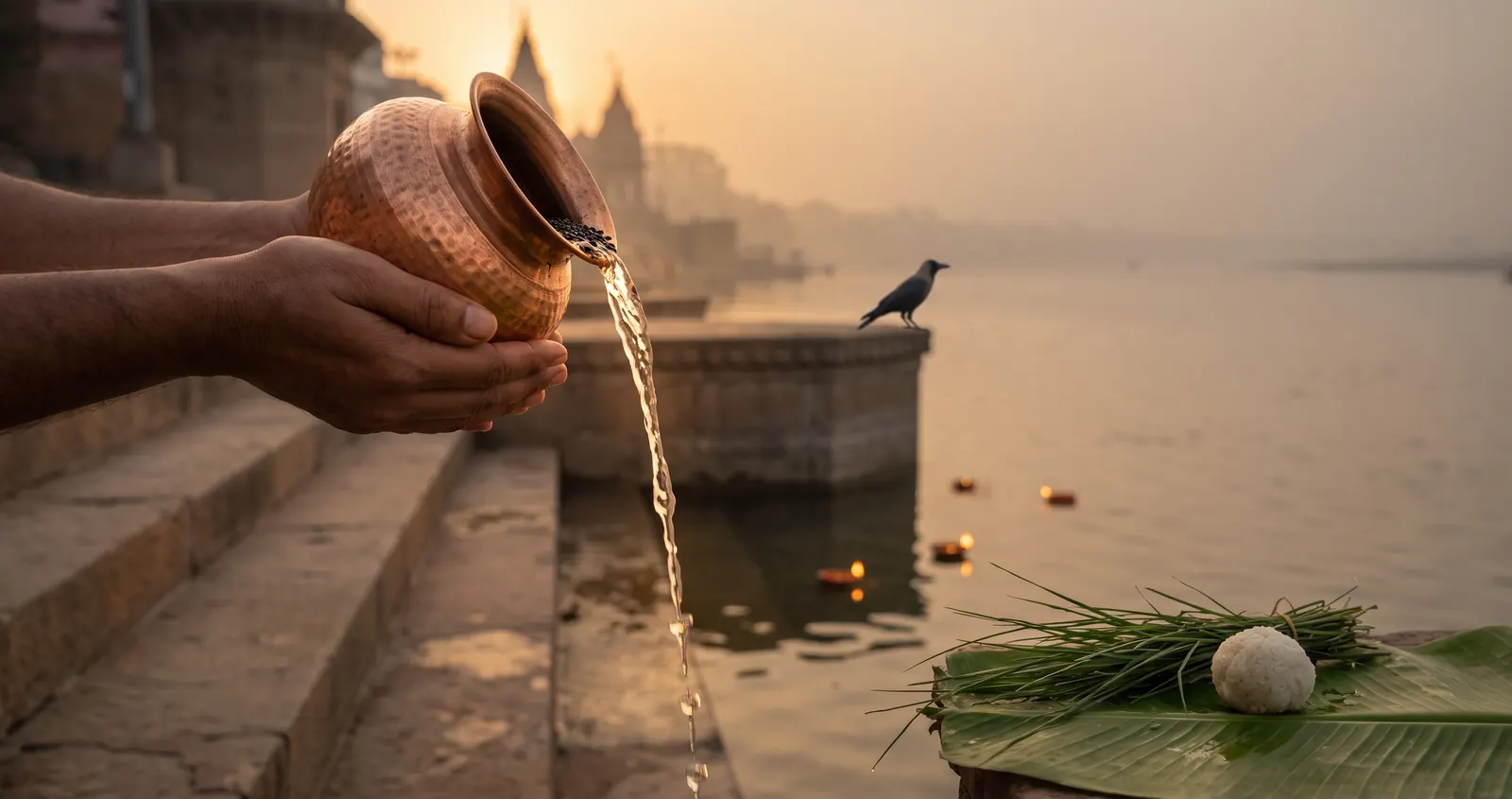
The three components of the ritual are distinct. Tarpan is the offering of water mixed with black sesame seeds. Pind Daan is the offering of rice balls representing the ancestral body. Brahman Bhojan is feeding a Brahmin, a guest or those in need, which is how the offering actually reaches the Pitrs according to the tradition.
- Bathe and face southThe southern direction is governed by Yama and is sacred to the Pitrs
- Offer TarpanWater with black sesame (kala til) and darbha grass, poured through the pitra tirtha - the base of the right thumb
- Prepare sattvic foodKheer, rice, ghee, and seasonal vegetables cooked without onion, garlic or salt-heavy preparation
- Offer Pind DaanRice balls mixed with barley flour, black sesame and ghee, offered with the ancestor's name and gotra
- Feed five recipientsTraditionally a cow, a dog, a crow, a deva offering (in fire) and a guest - the Panchbali offering
- Give charityFood, clothing, black sesame, an umbrella or shoes donated in the ancestor's name completes the ritual
- ReciteThe Pitru Gayatri, Pitru Suktam, or Garuda Purana verses if a priest is not available
What Should You Avoid During Pitru Paksha 2026?
Pitru Paksha is a period of restraint rather than celebration. These fifteen days are traditionally considered inauspicious for beginning anything new, because the fortnight belongs to the Pitrs and not to the Devas. The restrictions are ritual conventions - observe them with understanding, not fear.
- Avoid new beginningsWeddings, engagements, Griha Pravesh, business launches and vehicle purchases are traditionally postponed until after October 10, 2026
- Avoid non-vegetarian food, onion, garlic and alcoholSattvic discipline is central to the fortnight
- Avoid turning away a crow, cow, dog or guestIn this fortnight they are regarded as carriers of the ancestral offering
- Avoid new clothes, ornaments and haircutsPersonal adornment and hair-cutting or shaving are conventionally deferred
- Do not neglect the AmavasyaIf you can observe only one day, observe Sarva Pitru Amavasya on October 10, 2026
- Do avoid quarrels and harsh speechFamily discord during this fortnight is considered directly counterproductive to the purpose of the observance
The takeaway
Pitru Paksha 2026, from September 26 to October 10, is the most direct fifteen-day window in the entire Hindu calendar for clearing ancestral karma. Perform Shradh on the tithi your ancestor departed, use Sarva Pitru Amavasya on October 10 as the universal safety net, and let the fortnight's restraint prepare you for the auspicious season that opens with Navratri the very next day. If your chart shows Sun-Rahu or Sun-Ketu combinations, an afflicted ninth house, or if you have faced years of unexplained delay in marriage, children, property or career, a personalised Pitra Dosha analysis will identify exactly which lineage karma is active and which Shradh tithi and remedy applies to you. Book a 1-on-1 video consultation with Astrologer Sheela Goklani before the fortnight begins.
Book a consultation